
It is not that often that you get to do something you want to do, and those in authority over you not only are in favour of it but actively encourage it! There is an opportunity not to be missed.
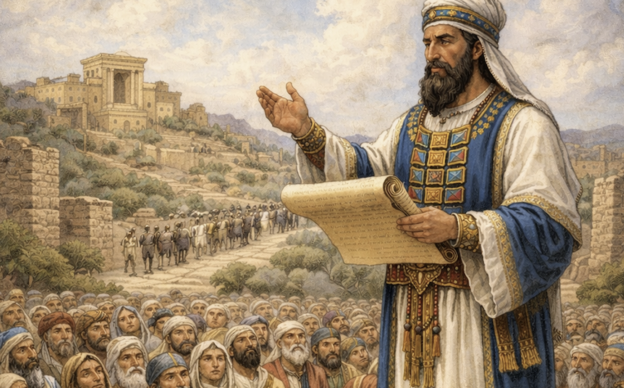
Ezra was a man who was placed in the blessed position. Ezra wanted to return to Jerusalem to reform worship and life there. Thankfully, he had the Persian king’s bidding and backing in his task. Yet this backing, whatever the human reasoning behind it, was ultimately based on God’s hand. Ezra truly was doing the king’s bidding – that of King Jesus.
From verse 11 of Ezra 7 onwards, we read the Persian king’s letter which authorised him to go about the king’s business in implementing his reforms (v.11). As the chief king, the Persian king authorised Ezra to head to Jerusalem, and any Jews who wanted to go with him to go along with him (vv.12-13).
Ezra was sent by the King and his cabinet of advisors “to make inquiries about Judah and Jerusalem according to the Law of your God, which is in your hand” (v.14). Persian kings were notable for their attitude towards the deities of their subjects. Basically, they wanted to keep sweet with them all, in case one of them affected their rule. So the Persian king’s interest in Judah’s observance of God’s Law was as much about good rule as it was covering his bases.
To make sure that Ezra succeeded in his reform, the king provided for silver and gold from his own funds, alongside that freely offered by devout Jewish believers (vv.15-16). With this money, Ezra was to buy the bulls and various offerings required for the proper sacrifices at the rebuilt temple (v.17). The rest was to be used at his discretion (v.18).
In addition, the king made sure that all the necessary vessels for sacrifices and washings were provided, either from being given or purchased from the kingdom’s funds (vv.19-20).
Further, the king directed all the treasurers of his domains “Beyond the River” which referred to the area of Judah and Syria, to provide a large amount of gold, silver, wheat, wine, oil, and salt which was a necessary part of the sacrificial system (vv.21-23). There would be no repeat of the bureaucratic delays that the temple builders faced.
Finally, the king provided tax relief for the priests, levites, and temple servants (v.24). This would have also served as an incentive to serve in these roles, rather than abandoning them for better-paying jobs elsewhere.
Clearly, the Persian King was concerned that God’s wrath might fall on him and his descendants (v.23). He figured all this could buy God’s favour. While we know it can’t, Ezra was not going to look a gift horse in the mouth.
But together with reforming the worship, Ezra was sent with a clear mission from the king. He was to reform the rule of law in Judah. He was to “appoint magistrates and judges who may judge all the people in the province Beyond the River, all such as know the laws of your God” (v.25). If any did not know these laws, he was to teach them (v.25).
This would not make Ezra popular. So Ezra was also to enforce the king’s weight behind those laws, whether that was confiscation of property, imprisonment, banishment, or death (v.26). Note that these were not what God’s Law required, but were what the Persian king required.
Ezra was much like a new Moses, leading exiles out of bondage with the wealth of the nations. He was also given God’s Law to teach to his people, and would face the same resistance and trouble.
Yet despite this, Ezra was thankful to God for giving the Persian King a mind to allow him to do all this, and the courage he would need for the task ahead (vv.27-8).
The same pragmatic concern of the Persian King is sometimes experienced in our world today. Many (though definitely not all) of our laws reflect God’s Law or its implications. For that, and the enforcement which our governments and judges provide, we should be thankful. While it is not perfect, and does not perfectly reflect God’s Law revealed completely (just as Ezra’s job mixed the Law with the Persian King’s punishments), it is still God’s hand at work in our society today to restrain evil.
Secondly, we should notice how Ezra was a second Moses. Later, another man like Moses would arise, to truly explain and teach God’s Law to his people. He would purify the worship of God, by offering the true sacrifice of himself for the people’s sins. That second Moses was Jesus, the true King of Kings.
Because while the Persian King was authorising Ezra to do his bidding, the Persian King was ultimately doing King Jesus’ bidding. Ezra was not just serving a Persian King, he was serving Jesus, by reforming worship and practice to glorify God and help prepare for King Jesus’ eventual arrival.