
One of the hard parts about reading and engaging with the Old Testament is understanding the special laws and obligations which fell on the Jewish people as they waited for the coming of Jesus. How do these apply to us, if at all? Some people make sharp distinctions and write the Old Testament off as history. Others use it to advance their pet prejudice or issue.
As Bible-believing Christians, it is important to do neither. We need to understand the point of the laws, and what they meant for the Jewish people and for us today in the light of Christ. That is true of Ezra’s objection to intermarriage. This was not based on racism, but religious purity. And importantly, Ezra’s response reminds us that whatever the corporate sin of our church in this day, the answer is the same as our own personal sins. To pray for God’s mercy.
After the long journey home, Ezra spent several months back in Judea and began his teaching ministry. Certain officials came to Ezra and identified a worrying issue. “The people of Israel and the priests and the Levites have not separated themselves from the peoples of the lands with their abominations” (v.1).
How had they not done so? “They have taken some of their daughters to be wives for themselves and for their sons, so that the holy race has mixed itself with the peoples of the lands. And in this faithlessness the hand of the officials and chief men has been foremost” (v.2).
God’s Law required the Jewish people to keep themselves separate from the pagan cultures surrounding them (Exodus 24:10-14; Deuteronomy 7:1-4). This was not about racism. It was about worship. At best, intermarriage introduced competing religions into a Jewish household and confused the kids. The reality was usually compromise and walking away from worshiping God. This was God’s chosen people. The people who would bring the Messiah. This could not happen.
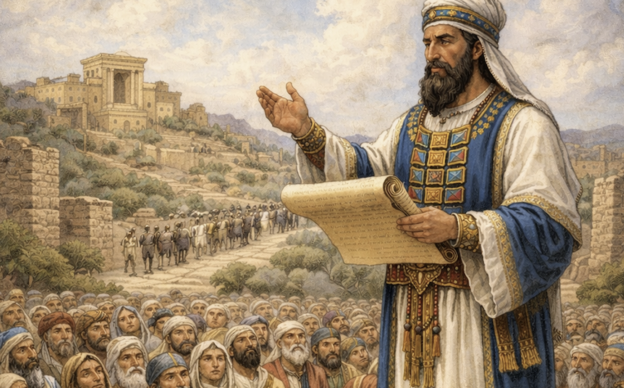
Ezra’s response reflected this concern. Ezra tears his garments in grief, and sits appalled (v.3). Why? Not because of bigotry, but because this was exactly how his people had ended up in exile years before. The video was playing again. Those who like Ezra desired to worship God faithfully joined him in mourning (v.4).
Then, finally, Ezra stood up, but to pray (v.5). Identifying himself with the covenant people he confessed “our iniquities have risen higher than our heads” (v.6). He also confessed it was also of long duration, “from the days of our fathers to this day” (v.7). There was no minimising the reality of sin or how long it had happened.
Yet despite this sin, God showed mercy “to leave us a remnant and to give us a secure hold within his holy place” (v.8). They are slaves to the Persians and deserve nothing less (v.9), but still God had “grant[ed] us a little reviving in our slavery” (v.8).
After this, Ezra moved specifically to the confession of the particular sin, where they had forsaken God’s commandments by intermarrying with unbelievers and being tempted into apostasy (vv.10-12). Despite the judgement which God had sent on them “for our evil deeds and for our great guilt” (v.13) and despite God punishing them “less than our iniquities deserved” (v.13) they had broken his commandments again (v.14).
Finally, Ezra placed themselves in God’s hands. There was no request for pardon. Rather, Ezra considered the possibility that God’s patience with them might have run out (v.14). Instead, all Ezra could do was recognise God’s justice, and acknowledge “we are before you in our guilt, for none can stand before you because of this” (v.15).
Ezra recognised the guilt that his people had gathered on themselves by reverting straight back to the very problems which had resulted in their judgement in the first place. As a result, he threw himself on God’s mercy. Ezra, and all the people, deserved nothing less than God’s just condemnation and wrath.
We too are in the same position. While our sins are different to theirs, in that context, we too are guilty of our own compromise with the world, to which we in different ways (whether literally or figuratively) unequally yoke ourselves. Those compromises affect our devotion to God, drawing us away from following him to following after the ways of this world.
Like Ezra, we too need to acknowledge and confess our guilt specifically. We must name our sins, recognising its reality and duration, not minimising it. We need to recognise that we are following in the sinful patterns of those before us, and throw ourselves upon God’s mercy.
Because God’s patience with his people does not run out. Ezra does not end here, it continues. God sent his promised Messiah, Jesus, through that remnant. God’s patience and mercy for our sin met his perfect justice and judgement at the Cross, when Jesus bore our sins and God’s judgement.
Like Ezra, when we pray for God’s mercy, we find his forgiveness in the Gospel.