
In our day of rugged individualism, the idea that we collectively bear responsibility and guilt for actions can come as a shock. How can the actions of others affect me? As Christians, we should not be as shocked as others. After all, we acknowledge that through Adam’s sin we all fell, and through Jesus’ righteousness we are made whole with God. Those are corporate acts on our behalf, even if performed by an individual.
Ezra’s grief over the resurgent sins of Israel led many of God’s People in Jerusalem and the surrounding area to confession and repentance. Seeing Ezra’s grief over their sin, their own consciences were pricked and they were drawn to acknowledge their need for forgiveness from God.
The joy of Ezra’s return had been shattered by the realisation that God’s People had been unfaithful to God’s Law by compromise with the pagan nations around them, expressed in their cultural context by intermarriage with unbelievers. This realisation had led Ezra to a great prayer to God, throwing himself and his people on God’s mercy.
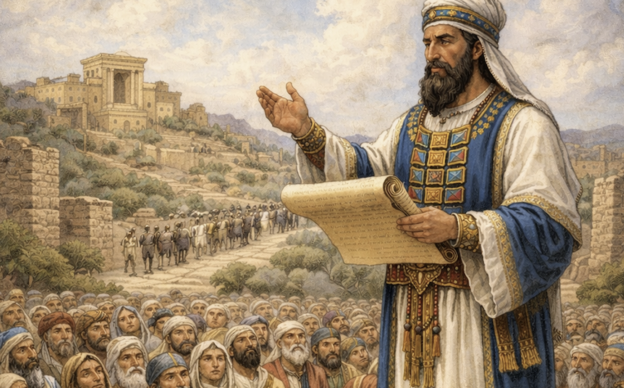
Ezra’s great prayer did not go unnoticed by others. While he prayed before the temple, “a very great assembly of men, women, and children, gathered to him out of Israel, for the people wept bitterly” (v.1). Ezra’s own heartfelt upset convicted others of their corporate wrongdoing.
Ezra’s leadership led an otherwise unknown man, Shecaniah, to confess “we have broken faith with our God and have married foreign women from the peoples of the land, but even now there is hope for Israel in spite of this” (v.2). He proposed that God’s people made a “covenant” to remove the office by sending away the wives and children in accordance with God’s Law (vv.3-4). These may not have been legal marriages but adulterous relationships, based on some of the Hebrew words used.
The issue continued to upset Ezra, and while he managed to get the people and leading priests and Levites to commit to the proposal, he still retreated to mourn (vv.5-6). Meanwhile, a proclamation was made to bring all the returned exiles to Jerusalem in three days unless they wanted to forfeit their property and be banned from the congregation (vv.7-8).
With the people assembled, sitting trembling because of the issue and the rain, Ezra explained how they had broken faith with God by their actions (vv.9-10). In a form of public hearing, Ezra demanded that the guilty “make confession to the LORD … and do his will” (v.11).
The assembly collectively responded that they would do so (v.12). The problem was, the rain and the number of people made it too hard to sort at once. So officials as representative leaders were to hear the cases and decide upon them (vv.13-14). Only a small number objected to this approach, one of which (Meshullam) probably objected because he himself was guilty (v.29).
Ezra selected men to act as the representatives of the people in hearing the cases (v.16). The number of cases becomes clear when the text tells us that it took three months to hear these cases and come to decisions (v.17).
The length of time indicated that it was a widespread passage. Ezra’s journey to reform the worship and morals of God’s People was clearly a necessary situation. There was widespread disrespect of God’s Law, and so the whole community was affected. Corporate repentance was required, and corporate action by the people to resolve the situation and restore them towards the holiness that they were to aspire to, as they awaited the coming of Jesus the Messiah in their midst.
This shows the leadership of Ezra, and the type of leadership that we should all aspire to. Where others had led the way in introducing sin into the community (9:2), Ezra led the way in repentance. Even though Ezra had not personally sinned, he knew that the people had sinned as a body and that they needed to repent. He identified with the people and sought God’s forgiveness.
That repentance brought the same from many of God’s People who observed him, and were convicted by the Holy Spirit to do the same. It also brought a sense of perspective, as it was Shecaniah who encouraged Ezra that all was not lost. Sometimes, leaders need reminding of God’s mercy too.
It was through Ezra’s leadership that repentance came to God’s People, and steps to restore the holiness (or, set-apartness) of the people. All of this was possible because of God’s mercy in not judging them as he ought to have straight away.
And this was possible because God sent Jesus to lead us to repentance. Even though Jesus never personally sinned, he knew that we as individuals and as a body needed forgiveness. Jesus identified with us and sought God’s forgiveness by offering his own perfect, sinless life as a sacrifice in our place, to wipe away our sins.
That sacrifice applied to us through conviction by the Holy Spirit, leads us to repentance and faith, making us holy before God.