
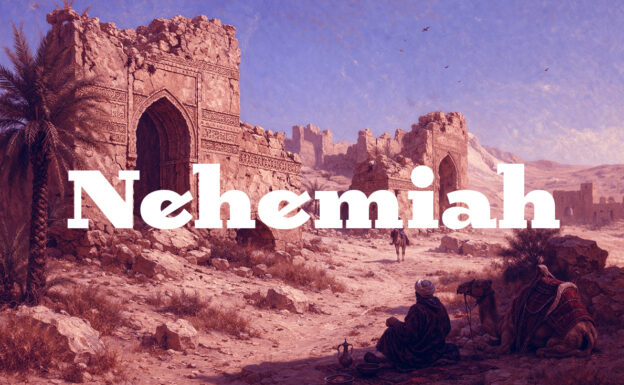
We live in a city and so see its appeal, but plenty of people think of cities as evil places. They are places where all sorts of sins occur, and where you can get your hands on anything (legal or illegal) you desire. Of course, all this occurs outside of cities too, but for some the appeal of a homestead life is at least as much about getting away from the city as it is a desire for chickens.
Scripture does not view cities as inherently evil things, but places where people and resources can pool together for mutual support and benefit. God saves people in cities, just as he saves outside of them. God’s Temple was placed in a city, and the New Creation is patterned at least in part on a heavenly city, to which Jerusalem was a model. So there was no point in rebuilding the walls of that model city without anyone to dwell within it.
The leaders of God’s people lived within Jerusalem, perhaps out of a sense of obligation (11:1). But to ensure there were enough residents, they drew lots to pick one out of ten in the land who would move to Jerusalem and inhabit it (v.2). This would have been a difficult move, involving sacrifice for the sake of God.
And so, we are confronted with another list. Firstly, a list of families who came to live in Jerusalem. This included those descended from Judah (vv.4-6) and Benjamin (vv.7-9).
These families were joined by priests (vv.10-14), Levites (vv.15-18), and Gatekeepers (v.19).
The rest of the Israelites, including priests and Levites, lived outside Jerusalem (v.20). The Temple servants were located in Ophel, with two men set over them in leadership (v.21). The Levites in Jerusalem were overseen to make sure that the Persian King’s commands to ensure that their worship work continued (vv.22-24).
Next is a list of villages outside Jerusalem where Israelites resettled and lived (vv.25-36).
Then, Nehemiah listed the priests and Levites who returned earlier, in the days of Zerubabbel (12:1-9). This was almost a century earlier. From that time, a series of High Priests were responsible for worship, and these are listed in verses ten and eleven.
Following this, Nehemiah lists the priests during the days of Joiakim (vv.12-21). Finally, further information about the Levite families who served the Temple at this same time is presented (vv.22-26).
Moving into Jerusalem was a real sacrifice. The Temple and the walls had been rebuilt, but the rest of the city was not in as fine a state of repair. The new residents gave up ready access to fields containing animals and crops, and became reliant on others for food supply.
Those who moved into the city, to ensure that the places that surrounded the Temple, bounded by the walls, remained occupied, did so to ensure that the morals of the surroundings did not mirror the state of the buildings. God’s presence with his people could not be surrounded by moral decay, as all too many cities often did.
This was not the sole duty of the young either. Each of the families mentioned were made up of men, women, and children. Those families held a responsibility to pass on and pass down the faith, through faithful prayers, teaching, and subjection to the Scriptures. When we read these lists, we are seeing a pattern of faithfulness in families, and a pattern of God’s blessing of the faithfulness.
With Jerusalem sitting near a major trade route between Egypt and the main Persian cities, an inhabited Jerusalem filled with families and developing its own culture centred around the worship of God in his Temple served as a vital witness to the surrounding nations. In their own way, these families who relocated were involved in a missionary endeavour.
The coming of Christ removes the Temple from one central city, Jerusalem, and places it everywhere that believers are present. Therefore, we no longer must gather in one particular place to be close to God’s presence. But rather, our presence in places brings God’s presence to those places.
Yet things still remain the same. The faith is still passed down through families. We are called to faithfully pray, teach, and subject ourselves to the Scriptures, trusting in Christ for forgiveness of sins and the Holy Spirit for its work in our children’s lives. As we do so we are extending the presence of God, and his residence to cities, towns, and farms across the Country. Our presence fights against the victory of moral decay over those places, as we are outposts of righteousness to the surrounding nations.
Like the Israelites of Nehemiah’s day, we all have different roles and responsibilities in daily life and in the Church. But our different roles and responsibilities do not interfere with our ability to serve God wherever we are, whatever we are doing. We are all part of a list written in God’s books of his servants here today, inhabiting this city in service to our God’s command.