
If we appreciate a composer or musician, we might express that by describing tunes or lyrics we appreciate. The same with an artist, where we will describe their art and the way that it expresses some aspect of them. There is a sense in which the music or images they create are an expression of them, that allows us to gain an understanding of them.
In Psalm 48, the psalmist uses Jerusalem as a way to praise God. God is identified with the city of Jerusalem, in a way in which the whole world is forced to acknowledge God’s existence and power. The psalm sings praises about Jerusalem as a way of signing praise to God. Ultimately, the destruction of Jerusalem reminds us that the city is just pointer to the reality of God in our midst.
Psalms 46 and 47 have taught us something about God. Here in Psalm 48, we learn about God through praise directed to his city, Jerusalem. The first three verses introduce us to this theme.
The psalm begins by proclaiming “great is the LORD and greatly to be praised in the city of our God!” (v.1). This city is then declared to be “his holy mountain” (v.1), which is “beautiful in elevation” and “joy of all the earth…the city of the great King” (v.2). Within it God is described as making “himself known as a fortress” (v.3). The phrase “great king” is a reference to the covenant relationship, where a great king entered into a pact with lesser rulers.
Interestingly, the description of Jerusalem is not literal. Jerusalem is not that high in elevation, not loved by everyone, and not in the “far north” (literally “beyond Zaphon”). Instead, the psalmist is identifying Jerusalem as the true “Zaphon” , a place in Canaanite belief where their gods dwelt. All praise really belongs to God, who can be found not at Zaphon but at Zion.
Next, Jerusalem is described from the perspective of enemy nations. The “kings assembled” (v.4) and were astounded, before fleeing in panic at its sight (v.5). Their terror is compared to the writhing of a woman with labour pains, or the terror of sailors as their ship is destroyed by a violent storm (vv.6-7).
The experience of history as shown in the Bible is that this terror was not based on the city’s physical layout. Instead, this terror must have come through perceiving God’s presence there, and realising they had come face to face with their greatest foe.
By comparison, the psalmist describes others who perceive Jerusalem with eyes of faith. The terror of the enemy nations compares to the “we” of pilgrims who arrive at the city and see not only the city of “the LORD of hosts…our God” but the city which God will “establish [make safe] forever” (v.8).
While the kings came to attack, the pilgrims came to worship. They recognise that just as God is not confined to one place, so too his praise reaches everywhere in Creation (v.10). God’s strength, his right hand, “is filled with righteousness” (v.10). This is cause for gladness and joy, and they call on all of God’s people to rejoice in God because of his just rule (v.11).
Perhaps as they worshiped, they walked around the city praising God. As they walked “about Zion” they looked at all her fortifications (vv.12-13). Then they would be able to tell others about how magnificent God’s city was.
But at the same time, they would get a clearer picture of their God, who is himself the real ramparts, towers, and citadels that those physical fortifications represented. This God would guide them through life, “forever and ever” (v.14).
The city described in this psalm was destroyed by the nations in 587 BC. Later it was rebuilt, and its walls and ramparts re-established, but destroyed again in 70 AD. The city of Jerusalem and God were not literally the same. The city, instead, pointed to a greater reality. It was just a shadow, pointing to the true presence of God among us.
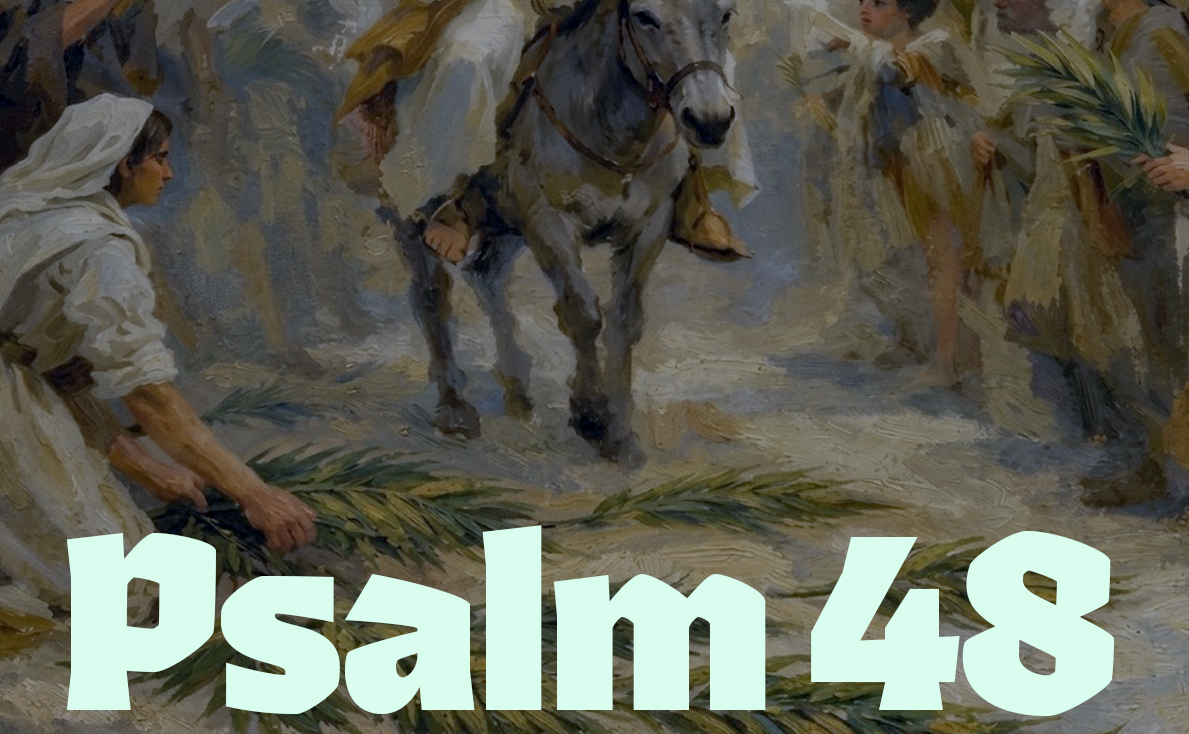
Before it was destroyed a second time, God came to dwell with his people and the great king rode into Jerusalem on a donkey. Jesus came to be the true embodiment of God’s presence, so we could come into his presence with joy.
Through the Holy Spirit, we are given eyes to see Jesus as our true fortification against the tragedies and attacks of this life. Instead of the fear and terror of the nations that will be fully revealed when Jesus comes again in just judgement and they call down rocks on themselves rather than face him (Rev. 6), we experience the joy and peace that comes with worshiping God in his presence.
One day, when Jesus returns and renews all things, we will fully enjoy the presence of God dwelling with us, his people, in his city. In the meantime, we call the nations to look not to their own Zaphon or Olympus, but to the heavenly Jerusalem where God dwells.