Archives

Ezra 8:21-36: Stepping out in faith

Read Ezra 8:21-36

Change is something which brings anxiety in even the best of us. Whether it is a career change, a relocation, starting a family and moving to one income, a significant commitment or any other adjustment to the life we lead, it is entirely natural to feel uncertainty and fear. Thankfully as believers we have the promise of God that whatever happens, it will ultimately work for our good in whatever way God has ordained.

For Ezra and those returning to Jerusalem, the journey was one of substantial change and danger. They were leaving behind the only places they knew, to go to a land they had never seen. They faced the prospect of banditry and death on the way. They needed the sovereign protection of God. Ezra’s anxiety points us to how we too can step out in faith, despite our fears, and trust God to lead us safely to him.

After Ezra gathered those returning with him to Jerusalem for the religious and political reforms so desperately needed, and convinced the lacking Levites to join the return, we might think the next step was to unpitch the tents and hit the road. But it was not.

Instead, Ezra “proclaimed a fast there, at the river Ahava, that we might humble ourselves before our God, to seek from him a safe journey for ourselves, our children, and all our goods” (v.21).

Ezra and his group were quite understandably nervous. While we do not usually worry about a road trip to another city, the journey ahead of them was quite dangerous. Bandits and thieves were a common reality, even for the humble traveller. 

But this was no poor group of pilgrims. Ezra tells us in verses 25 to 30 of the substantial gold and silver items which they were taking back to Jerusalem. So many, that priestly guards had to be arranged to watch over and account for the sum and value of these items. A plot line for a heist movie, in other words.

And so Ezra and his thousands of supporters fasted and prayed for three days, for God’s protection. They were especially reliant on him, because Ezra felt that they needed to demonstrate God’s superiority to the false gods around, and he had declined troops from the king as a result (v.22). In other words, Ezra had likely proclaimed the truths of Scripture. Now, the rubber was hitting the road and he had to live by his words. Sounds familiar to me.

Thankfully, God “listened to our entreaty” as they fasted and prayed and implored his protective hand, trusting in God’s goodness “on all who seek him” (vv.22-3). An older Ezra, writing his tale, could look back and see God’s goodness displayed.

After their time of fasting, they departed “from the river Ahava on the twelfth day of the first month, to go to Jerusalem” (v.31). And how did the journey go? Little we know for certain, except the most important thing. “The hand of our God was on us, and he delivered us from the hand of the enemy and from ambushes by the way” (v.31).

They stepped out in faith, and arrived at their destination. “We came to Jerusalem” (v.32). They rested for three days, and then on the fourth day carefully counted out and weighed the gold and silver goods carried back for use in the Temple (vv.33-4). The lack of further note suggests that what left Babylon arrived in Jerusalem.

What then was left, after four months of travel? After the laughter and the fear, the uncertain steps and the safe arrival? What else, but worship! They offered “burnt offerings to the God of Israel, twelve bulls for all Israel, ninety-six rams, seventy-seven lambs, and as a sin offering twelve male goats” (v.35). They were Israel: God’s people, in God’s place, worshiping God. Handing out the king’s commissions to his governors (v.36) was an appendix to the most important thing. Praising God.

Ezra’s example is one we can follow as well as we walk through our own seasons of change. As believers, we know that for all those in Christ God works all things together for our good, just as Ezra could proclaim “the hand of our God is for good on all who seek him”. Same God, same goodness.

Same approach. Turn to God in prayer. Cast your worries on his goodness. Step out trusting God, that the outcome will show God’s goodness, be for your good, and bring God glory.

Walking through change does not take away our worries. But in the journey, God is with us. Walking that path in prayer, trusting in God’s goodness, helps us on the journey. Because through drawing close to God, we feel his presence with us.

One way or another, we will reach the end of that change. Whether it is a stop on the road of this life, or the end of this life and its many changes. And there, in God’s presence, we shall follow Ezra’s example once more. We shall worship God there!
Ezra 8:15-20: Lacking Levites

Read Ezra 8:15-20

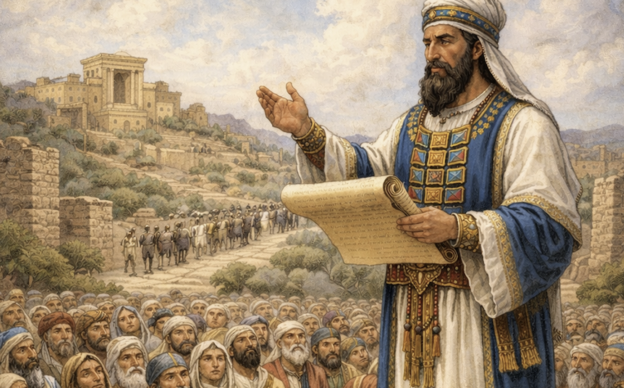
Whether it is a sports club, a hobby group, a church, or any other sort of organisation, there is always a need for volunteers and helpers. People who do not mind working away at their part of the bigger picture, helping all the cogs turn, and making sure things happen. Take a look around at church this Sunday and note all the different people and the different things they do to make our church and its various outreaches run! It is far more than just the ones with the titles. They are our real unsung heroes.

The Old Testament people of God were no different. There were plenty of important tasks to ensure the proper worship of God which had to be done, and were assigned to the Levites. The Levites were integral in making sure that the Temple and the Priests were doing exactly as they were meant. So for Ezra, the lack of Levites in the initial group of returnees was concerning. But God provided, as God always does. And God provides for the service of his kingdom here today, as he always has.

Ezra was returning to Jerusalem to bring about further reform of the worship and rule of God’s People there. He went as a man appointed by his earthly king, on the command of his Heavenly King. He did not travel alone, but with thousands of other returnees.

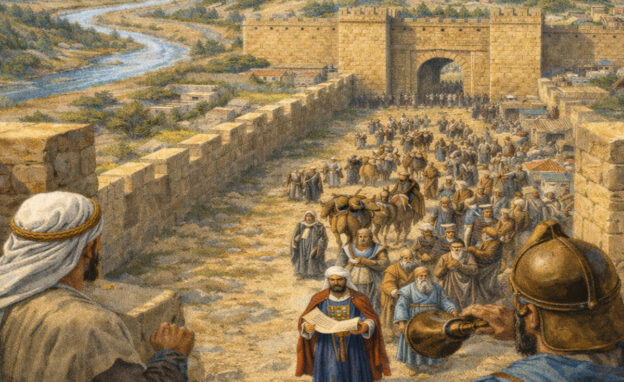
A trip of this nature was tough, time consuming, and dangerous. You needed to be prepared, both for the trip and for when you arrived. Food and other provisions, and security were required. Access to a river was important. No doubt that was why Ezra and his travellers gathered near part of the Euphrates River system, at “ the river that runs to Ahava” (v.15). 

There, they camped for three days and Ezra reviewed who had come (v.15). But there was a problem. Ezra lacked Levites! If his reforms were going to take root and bear fruit, then Levites were an integral part. A missing piece of the puzzle.

So Ezra sent for leading men among the Jews, “Eliezer, Ariel, Shemaiah, Elnathan, Jarib, Elnathan, Nathan, Zechariah, and Meshullam, leading men, and for Joiarib and Elnathan, who were men of insight” (v.16). Ezra was an organiser, but he needed help from men who knew how to influence. So these men were sent to Iddo, a leading man in a now unknown place called Casiphia, to rustle up some Levites to head back to Jerusalem (v.17).

Ezra told them what to say, to encourage these Levites to respond to the holy task which God had appointed their ancestors to (and by descent, them). While Ezra probably could have called on royal troops to press-gang Levites into the party, this was not his approach. Persuasion yes, but ultimately men responding from the heart to the summons.

The persuasion was successful. Eighteen descendents of Mahli, along with 20 descendants of Mehrari, answered the call (vv.18-19). One of these men, Sherebiah, is a particular “man of discretion” (v.18) indicating his great worth to Ezra and his task. Together with these 38 Levites, Ezra’s persuaders found “220 of the temple servants, whom David and his officials had set apart to attend the Levites” (v.20).

All of this was not merely the best efforts of charismatic men and an administrative guru. Rather it was “the good hand of our God on us” (v.18) to grant Ezra that which he needed for the task ahead of him.

Notice that Ezra did not “let go and let God” in solving the lacking Levites problem. Ezra clearly trusted in God to provide all that he would need, but he still used his brain to think through the problem, engage the right people, and provide the right arguments. Trusting in God does not mean that we check our brains at the door, or wait passively for God to provide. We must still use the talents and abilities that God gives us, and others around us, to be instruments of God’s will.

Note also that there were a variety of those gifts given. Ezra was clearly an administrator. A man who liked to organise things. But he was not the best man to persuade a bunch of Levites to leave behind their lives, family members, and way of living for the uncertain future. Others were perfect for that. The church is just the same today. God prides us all with the unique connections and contributions we make to serving God in his kingdom. 

We all have different giftings and abilities, natural and spiritual. We all have a part to play. Some of us may even be the person “of discretion” needed for one particular task!

This all works because God is faithful to his promise. God appointed Levites to special tasks for his glory, and provided Levites for Ezra’s task. God appoints individuals to build his church today, and provides them for Christ’s tasks. Where there are servants lacking, God provides the number he desires for the task by his good hand.


Ezra 8:1-14: Exiles Come Home

Read Ezra 8:1-14

Oh great, another list. While lists and charts may tickle the fancies of us who like to put ducks in a row and administer things smoothly, it is hardly the most enjoyable reading. In the Bible, it is a tempting target for a bounce to the next section (come on, confess, you all have at least considered it). What does another list have to do with helping me grow to become more like Christ?

The answer is in the details. There are subtle pieces of information that teach us about how God was still working out his plan of salvation. Whether it is family groups, passing references to identities, or the number of families who returned with Ezra, Ezra’s meticulous record keeping and diarising is not just intended for the appendices to the Scriptures but to point us to Christ.

This section of Ezra is written in the first person. It may reflect the personal diary of Ezra the government official, recording what he did and why. As a servant of God, it serves the same purpose. And because it is in the Bible, it was written for our benefit.

In a culture, largely unlike ours, which put huge value on family lineage, the list records “the heads of their fathers’ houses, and … the genealogy of those who went up with me from Babylonia, in the reign of Artaxerxes the king” (v.1). Ezra recorded this because it gave weight to who returned. 

It also showed, when compared to the first returnee list in Ezra 2, that all but one (Joab’s family, v.9) were following after the first pioneers. Families had divided over whether to stay or go. But clearly, lines of communication between the family groups remained open over the decades. The group who returned with Ezra would have learned of the progress and spiritual condition (or lack of it) in Jerusalem. They went to join their family members who had gone before them.

We also note that two priestly families returned. They are listed first, as sons of Phineas and Ithamar (v.2). We do not know why these priestly sons remained in the first place, but perhaps they were serving the Jews who remained in Babylon. Eventually, the call for them to leave and return came to them too.

There is also a son of David, Hattush, who returned (v.2). Whether Hattush sits somewhere in Matthew’s genealogy of Jesus, which may have skipped generations, is not known. But it does further show God’s favour to the line of David which, despite not having a king on Judah’s throne for more than a century, was still continuing on quietly until Jesus came.

And what of the other names in the list (vv.3-14)? They represent a cross section of the Jewish people. Specifically, twelve families. That is no mistake. Twelve tribes. Twelve disciples. Twelve families. God is sending a message about his people in Ezra’s list. God was still working to preserve his complete people.

And speaking of completeness, the sons of Adonikam “those who came later” also appear in this list (v.13). The phrase quoted can also be translated “the last ones”. While we cannot say for certain, this may refer to the remainder of an entire family line who followed Ezra from Babylon to Jerusalem, reunited with their brothers in Judah.

This listing is not an accident. It was placed here on purpose. God is telling us how he is working his salvation plan out, even in the little pieces of migratory movements. He is also reminding us of what is truly important.

Whether or not the number is larger (as in Ezra 2) or smaller (as here), God is working to save and preserve a people for himself. He is calling people from exile to his presence, to serve and worship him.

This list also gives us a cultural check. In our culture, youth is idolised. Everyone wants to look young. Sometimes it feels like everything is catered to children, including the way some churches focus their strategy for evangelism. But the Bible looks at it the reverse. Perhaps we have missed something. 

We should never neglect our children, who are important and valued gifts from God. Nor should we forget it is the home, particularly the Christian home, and the pulpit, that are where our children are properly formed. They cannot be formed if they are not well led by their parents, and especially wherever possible by a husband and father pursuing godliness in his personal life. As one myself, I pray that God would shape me in godliness as a better husband and father every day. This is something all of us can pray for, whatever our circumstances.

We can trust that faithful, patient Christian formation in the home and from the pulpit works because of God’s promises. And we can trust God’s promises, because even in this passage, God kept his promise to bring home exiles, and preserve David’s line. So in time, our Saviour and King Jesus, would come and bring us safely home to God’s presence.


Ezra 7:11-28: Doing the King’s Bidding

Read Ezra 7:11-28

It is not that often that you get to do something you want to do, and those in authority over you not only are in favour of it but actively encourage it! There is an opportunity not to be missed. 

Ezra was a man who was placed in the blessed position. Ezra wanted to return to Jerusalem to reform worship and life there. Thankfully, he had the Persian king’s bidding and backing in his task. Yet this backing, whatever the human reasoning behind it, was ultimately based on God’s hand. Ezra truly was doing the king’s bidding – that of King Jesus.

From verse 11 of Ezra 7 onwards, we read the Persian king’s letter which authorised him to go about the king’s business in implementing his reforms (v.11). As the chief king, the Persian king authorised Ezra to head to Jerusalem, and any Jews who wanted to go with him to go along with him (vv.12-13).

Ezra was sent by the King and his cabinet of advisors “to make inquiries about Judah and Jerusalem according to the Law of your God, which is in your hand” (v.14). Persian kings were notable for their attitude towards the deities of their subjects. Basically, they wanted to keep sweet with them all, in case one of them affected their rule. So the Persian king’s interest in Judah’s observance of God’s Law was as much about good rule as it was covering his bases.

To make sure that Ezra succeeded in his reform, the king provided for silver and gold from his own funds, alongside that freely offered by devout Jewish believers (vv.15-16). With this money, Ezra was to buy the bulls and various offerings required for the proper sacrifices at the rebuilt temple (v.17). The rest was to be used at his discretion (v.18).

In addition, the king made sure that all the necessary vessels for sacrifices and washings were provided, either from being given or purchased from the kingdom’s funds (vv.19-20).

Further, the king directed all the treasurers of his domains “Beyond the River” which referred to the area of Judah and Syria, to provide a large amount of gold, silver, wheat, wine, oil, and salt which was a necessary part of the sacrificial system (vv.21-23). There would be no repeat of the bureaucratic delays that the temple builders faced.

Finally, the king provided tax relief for the priests, levites, and temple servants (v.24). This would have also served as an incentive to serve in these roles, rather than abandoning them for better-paying jobs elsewhere.

Clearly, the Persian King was concerned that God’s wrath might fall on him and his descendants (v.23). He figured all this could buy God’s favour. While we know it can’t, Ezra was not going to look a gift horse in the mouth.

But together with reforming the worship, Ezra was sent with a clear mission from the king. He was to reform the rule of law in Judah. He was to “appoint magistrates and judges who may judge all the people in the province Beyond the River, all such as know the laws of your God” (v.25). If any did not know these laws, he was to teach them (v.25).

This would not make Ezra popular. So Ezra was also to enforce the king’s weight behind those laws, whether that was confiscation of property, imprisonment, banishment, or death (v.26). Note that these were not what God’s Law required, but were what the Persian king required.

Ezra was much like a new Moses, leading exiles out of bondage with the wealth of the nations. He was also given God’s Law to teach to his people, and would face the same resistance and trouble.

Yet despite this, Ezra was thankful to God for giving the Persian King a mind to allow him to do all this, and the courage he would need for the task ahead (vv.27-8).

The same pragmatic concern of the Persian King is sometimes experienced in our world today. Many (though definitely not all) of our laws reflect God’s Law or its implications. For that, and the enforcement which our governments and judges provide, we should be thankful. While it is not perfect, and does not perfectly reflect God’s Law revealed completely (just as Ezra’s job mixed the Law with the Persian King’s punishments), it is still God’s hand at work in our society today to restrain evil.

Secondly, we should notice how Ezra was a second Moses. Later, another man like Moses would arise, to truly explain and teach God’s Law to his people. He would purify the worship of God, by offering the true sacrifice of himself for the people’s sins. That second Moses was Jesus, the true King of Kings.

Because while the Persian King was authorising Ezra to do his bidding, the Persian King was ultimately doing King Jesus’ bidding. Ezra was not just serving a Persian King, he was serving Jesus, by reforming worship and practice to glorify God and help prepare for King Jesus’ eventual arrival.


Ezra 7:1-10: Ezra Arrives On Scene

Read Ezra 7:1-10

Sometimes the names of some of the Bible’s books can be a little confusing. Why are 1 and 2 Samuel named after Samuel, when he is prominent only in the first part of the first book, and David is the main character of most of the two? Why is Ezra named as it is, when he does not appear in the first six chapters? Good questions for heaven. 

In the meantime, Ezra finally arrives on scene in chapter 7 of Ezra, both literarily and literally. These first ten verses give us an indication of who this man is, why he has come to Jerusalem, and why God has chosen Ezra for his mission. We see a snapshot of Ezra’s credentials, Ezra’s commissioning, and Ezra’s compulsion. In this snapshot, we see a glimpse of Christ’s same mission, and in Ezra’s conduct a pattern for our own out of a thankful desire to please God.

Nearly sixty years pass between the end of chapter 6 and the beginning of chapter 7. At the end of chapter 6, a group of exiles had returned. They had rebuilt the altar, endured twenty years of oppression and resistance, rebuilt the temple, resumed worship, and celebrated God’s goodness to them. All must now be well, right?

Sadly not. The years rolled on. Praise became pattern. Rejoicing became expectancy, and then complacency. The hard lessons of exile and loss were not passed on. Even God’s deliverance of his people through Esther and Mordecai did not stop the decline. And so, reformation had to come again to Jerusalem. And thus, Ezra arrives on scene.

Ezra was descended from Jews who had stayed in exile, when the first hardy exiles returned. Some of the priests and leaders of the Jews would need to stay, to ensure that the Jews who remained were led and guided in how to worship God in a strange land. Ezra’s grandparents were in that band.

The first five verses of chapter 7 give a genealogical background for Ezra. While for most of us that is yawn inducing, unless we like to dabble in ancestry websites online, for Ezra’s day and culture it was extremely important. It introduced Ezra’s credentials to lead.

Ezra’s credentials were significant. Ezra’s priestly line goes back to Aaron (vv.1-5), through Zadok the priest (who anointed Solomon), Hilkiah who served during Josiah’s reforms (2 Kings 22), and Seraiah who served when Judah fell. While he was not the high priest himself, Ezra’s ancestors hit all the right notes of Israel’s worship. He was not someone to casually dismiss.

Yet why had Ezra come? The answer was that he was commissioned. Ezra “was a scribe” which marks him out as a trusted government official, who was also “skilled in the Law of Moses that the LORD… had given” (v.6). It seems that he was sent by the Persian King, perhaps to report on the situation there, by Ezra’s own request. But this was “for the hand of the LORD his God was on him” (v.6). King Artaxerxes may have sent Ezra, but it was God who commissioned and sent Ezra.

Yet the text also indicates that Ezra wanted to go. So what compelled Ezra to leave Babylon’s comforts and return to Jerusalem? It was not an easy trip, taking four months (v.8), along with “some of the people of Israel, and some of the priests and Levites, the singers and gatekeepers, and the temple servants” (v.7). Dangers from nature and bandits lay along the way.

The answer is that “the good hand of his God was on him” (v.9), because “Ezra had set his heart to study the Law of the LORD, and to do it and to teach his statutes and rules in Israel” (v.10).

Ezra was a reformer. He had been captured by God’s goodness and grace, and delighted to learn how he could please God, and to pass that on to God’s people in Israel, starting in Jerusalem where God’s temple sat.

Ezra was not in it for the money. Ezra wanted God’s glory. Ezra wanted God’s people to live in ways which honoured God. It compelled him.

In Ezra, we see a picture of Jesus. If Ezra is pictured here as credentialled, commissioned, and compelled for God, how much more is Jesus! Ezra traced his line to Aaron through Zadok. Jesus’ line traces to Adam through David. God sent Ezra through the Persian King, but spoke publicly to commission Jesus as his beloved son in whom he was pleased! And Ezra delighted to learn God’s Law, but Jesus not only embodied it but fulfilled it for us, in his life and his death for our sins on the Cross.

Because of Jesus’ success in his divine mission, we are lovingly restored to God’s presence in his church. Like Ezra, captured by God’s goodness and grace, we have the privilege of learning how to please and thank God by following his commands, and are compelled to faithfully hold Scripture’s truths as a new generation.

Because Jesus, like Ezra before, arrived on scene.


Isaiah 11:10-16: Signal for the Nations

Read Isaiah 11:10-16

In recent months I have been introducing my children to a Christian broadcast music station in the car (it’s easier than swapping bluetooth connections in a Jap Import). My younger son has been grappling with the concept of the station being nationwide, and I have explained to him that they broadcast a radio signal for everyone to tune into in towns across the nation.

Last week we saw Jesus described prophetically as a shoot from the stump of Jesse. Not just another king, Isaiah 11 promised the universal righteous reign and rule of Jesus, who would defeat all the nations, will rule and reign in righteousness, banish the effects and power of sin, and remove the curse so we can dwell with God in peace. But Isaiah also tells us he would be a signal for the nations, reconciling them to God. Through Jesus, God is gathering and restoring God’s People and defeating his enemies.

Verse ten serves as a bridging verse between the first nine verses of the chapter, and those that follow. “In that day the root of Jesse, who shall stand as a signal for the peoples—of him shall the nations inquire, and his resting place shall be glorious” (v.10). Previous verses had promised that the Messiah’s arrival would remake the cosmic order, reversing the Fall and reconciling predator and prey.

Verse ten promised this reconciliation would also extend to the reconciliation of the nations to the Messiah of God in Christ, lifted up on the Cross to draw all people to himself. While individual gentiles had always joined themselves to God’s covenant people (for example, Rahab, Ruth, or Naaman), the messianic shoot would bring about the fulfilment of God’s promise to Abraham that in him all the nations would be blessed.

Paul quotes from Isaiah 11:10 in Romans 15:12, leaving out “in that day”, to emphasise that this day had arrived with Christ’s coming. It is not something still to come, but something that is here today.

Jesus’ birth would also bring about  the gathering of the remnant and the restoration of unity amongst God’s People. Isaiah spoke of God “extend[ing] his hand” and regathering his people through a second exodus from “Assyria, from Egypt, from Pathros, from Cush, from Elam, from Shinar, from Hamath, and from the coastlands of the sea” (v.11). Those exiled from both the Northern and Southern kingdoms would be gathered from “the four corners of the earth” and the past divisions and conflict between the two kingdoms, which had run for hundreds of years since the time of Rehoboam, set aside (vv.12-13).

This was a figure of speech describing in categories familiar to God’s People in Isaiah’s day the gathering of God’s elect who confess faith in Jesus Christ their Messiah from all the nations of the earth. This fulfillment was only truly realised in the Church, God’s New Covenant gathering of people, which Christ instituted.

The gathering of God’s People from a second, end-time exodus, would also see the decisive defeat of the enemies of God’s People in the reign of the promised Messiah. The traditional enemies of Israel; Philistia, Edom, Moab, and Ammon, would be swept over by God’s People (v.14). God would destroy the traditional adversaries to Israel’s South (Egypt) and the North (Babylon) to enable the second exodus of his people from those places (v.15). To confirm this prophecy, God provides an image of a highway from Assyria for the remnant to return by, just as God led them out of Egypt (v.16). The implication of this image was that God would defeat Assyria, just as Egypt was in the Exodus.

When we think of a poor baby born in a manger, in little Bethlehem, all of this seems so far off. Yet the wise men from the East recognised that baby Jesus was no ordinary child, and brought gifts to prove it.

Jesus’ birth is not just a story of presents and angels singing in the sky, it is the arrival of the Messiah, God’s signal to the nations, that they too could retune their radios from the static of sin to embrace the frequency of reconciliation to God.

Jesus was God fulfilling his promises made all the way back in the Garden, in the very curse which banished us. Through believing in Jesus, we inherit the blessing promised to the nations through Abraham. We are liberated from the ever-present enemies of sin and death, far more terrible enemies than historic Israel’s enemies to its north or the most evil of enemies today. One day, every enemy will be finally placed under Jesus’ feet.

This is not a promise which is a far off, currently unrealised hope. It is something which Paul confidently believed is happening now. “In that day” is not in the future, it is today. “In that day” is now, because in a little back-country town, the Eternal Word was born a little baby boy to defeat sin and death, and be a signal for the nations. Tune your hearts to hear this Christmas.


Isaiah 11:1-9: The Righteous Shoot

Read Isaiah 11:1-9

Last week our Christmas tree sprouted again in our lounge. Christmas has arrived, and with it the indoor and outdoor decorations that add colour to this time of year, and my admiration for my wife’s creativity and decorative flourish. The Christmas tree’s origins and message are disputed, but one thing not in dispute is that the prophet Isaiah spoke of Jesus, the Messiah, as a shoot from the stump of Jesse.

While Christmas typically takes us to the wonderful passages of Isaiah 7 and 9, the coming Messiah was prophesied throughout Isaiah and the whole Old Testament. In Isaiah 11, the coming of the Messiah promises the universal righteous reign and rule of Jesus, our Saviour. Jesus’ arrival promised more than an earthly king, it promised the arrival of a truly faithful and righteous leader and the remaking of the cosmic order.

In approximately 700 BC, the promises of God were difficult to understand. God spoke to his people through his prophet Isaiah promising them that the problems of unrighteous kings and unholy world powers trampling all over their real estate were not the end of things. Using concepts and ideas familiar to Isaiah’s hearers, God promised that better days were coming.

Faced with an ungodly and unfaithful King Ahaz, and the nation of Assyria on the prowl, things did not look good for the faithful Israelites living in the Southern Kingdom of Judah (hundreds of years prior, Israel and Judah had split after Solomon’s reign). But the Assyrians would be chopped down like a forest (Isaiah 10), and the unfaithful kings would also be felled.

From that stump would “come forth a shoot from the stump of Jesse, and a branch from his roots shall bear fruit” (v.1). This was not just another Davidic king, but another David. God’s spirit would rest on this new King David, with threefold gifts. He would have “the Spirit of wisdom and understanding” to lead, “the Spirit of counsel and might” for war, and “the Spirit of knowledge and the fear of the LORD” to spiritually lead his people (v.2).

Unlike their unfaithful kings, this promised shoot would delight in serving God instead of his own desires, and would reign in righteousness and faithfulness, especially to the meek and the poor (vv.2-5). He would not judge based on appearances but on the heart, with righteousness and faithfulness adorning him like a belt around him.

The reign of the messianic shoot would also bring about a dramatic change in the circumstances of God’s People. Isaiah used the picture of the transformation of nature to describe the effects on Creation of the Messiah. “The wolf shall dwell with the lamb, and the leopard shall lie down with the young goat…” (v.6). Predators lying down peacefully with their prey, led by little children rather than attacking and consuming.

The imagery goes further. Carnivores will consume vegetation rather than other animals, alongside oxen and cows (v.7). Young children would provocatively place their hands in harm’s way, yet not suffer harm (v.8). Finally, speaking as God’s mouthpiece the prophet announces that “my holy mountain” will no longer face attack or destruction, because “the earth shall be full of the knowledge of the LORD as the waters cover the sea” (v.9).

Creation would return to its Edenic, pre-Fall state. These verses picture a situation where there is no longer trouble and disharmony, going beyond the absence of Assyrian or Babylonian devastations to Creation-wide peace and prosperity.

These verses promised God’s people that the arrival of Jesus was not just about restoring things to the best they got under David and Solomon, still both affected by sin, but to the ideal which David and Solomon’s reigns pointed to. The whole cosmic order would be remade, and sin and death banished.

The veiled reference to another David, who reigns in righteousness and faithfulness, visiting mercy on the meek and poor, pointed forward to Jesus. Jesus not only reigned in righteousness, but is the embodiment of God’s righteousness. Pleased as man with men to dwell, Jesus is our Immanuel – God with us. God’s Spirit was upon Jesus, and Jesus could judge with perfect righteousness because he knows what is in the heart of man (John 2:24-5). Jesus’ kingdom will ultimately defeat all nations, great and small, that oppose it, just as Jesus defeated sin and death at the Cross.

Further, the talk of the Messianic age being one of peaceful coexistence between predator and prey means the decisive defeat of the effects and power of sin. The reconciliation of carnivorous and herbivorous animals, and the exercise of dominion by even young children (bearing nevertheless God’s Image) describes paradise restored. Serpents not biting young children points to a removal of the curse.

Jesus’ birth means more than presents. It means the arrival of our Saviour, who would defeat all the nations, will rule and reign in righteousness, banish the effects and power of sin, and remove the curse so we can dwell with God in peace. Doesn’t that make you even more excited for Christmas?


Ezra 6:19-22: New Exodus, New Passover

Read Ezra 6:19-22

We are now in December, which means even the most grinch-like among us permit Christmas music and decorations. Christmas and Easter are two of the most important “festivals” associated with Christianity (well, most of us anyway), representing the birth and then the death and resurrection of our Lord Jesus Christ. For the Jews, their most important festival was the Passover, which commemorated God’s rescue of their ancestors from slavery in Egypt.

The returned exiles had finally restored and rebuilt the temple in Jerusalem, and in March 516 BC celebrated its completion. In April, they celebrated the Passover for the first time in decades. Just as God had brought their ancestors out of slavery in Egypt, now God had brought them out in a new exodus from their exile. So they celebrated the Passover that looked back, and that looked forward to the New Exodus and the New Passover that was yet to come. The one we celebrate at Christmas and Easter each year.

The date was monumental. With the temple rebuilt, the Jews who had returned from exile could celebrate the Passover once again. For decades, the feast had remained unobserved, because it could only be observed in the place where God’s presence dwelt (Deut. 16:1-8). With no temple in Jerusalem, there was nowhere for the sacrifices to be offered. But now, “on the fourteenth day of the first month, the returned exiles kept the Passover” (v.14).

The Passover looked back to the day of God’s divine judgement on Egypt, as Pharaoh refused to let God’s People go. God swept through the land and took the firstborn son of every household in one night, the final terrible plague visited on Egypt. Only the blood of a lamb, sacrificed and painted on the door frames of Israelite houses, caused God to pass over their households and spare their sons from the terrible wrath of God. A lamb in place of a man. Sacrifice of a lamb to avert the wrath of God. Spared, God led them out of Egypt to the wilderness and onward to the Promised Land.

For the returned exiles, their return was a second type of exodus. They had departed from a type of slavery in a foreign land, released by God’s sovereign power through the decree of King Cyrus, to return to the land which God promised to Abraham, Isaac, and Jacob. The Passover festival, not just because of its importance and the long gap between observances, held a special significance for them.

And so, the 1,000 or so Priests and Levites purified themselves and the Levites slaughtered the passover lambs for the tens of thousands of returned exiles, thousands of lambs for thousands of households, for the priests, and for themselves (v.20). Just as hundreds of years later, on the day and at the time of the passover, the priests and Levites would cause another lamb to be slain instead of man, so God might pass over.

Once the lambs were slain, and the choicest fatty portions offered to God, the lambs were taken home to households where Exodus 12 was read and a feast was held. And so it happened, that “it was eaten by the people of Israel who had returned from exile” (v.21). But not just them, but also “every one who had joined them and separated himself from the uncleanness of the peoples of the land to worship the LORD, the God of Israel” (v.21). Even in those days, God’s Israel was more than just ethnic Jews but also those from the nations who turned away from their gods to worship the only true God.

Following this, “they kept the Feast of Unleavened Bread seven days with joy, for the LORD had made them joyful” (v.22). After all, why should they not rejoice? Even their ancient enemy, the Kingdom of Assyria, now absorbed into the Kingdom of Persia (he was also King of Assyria by conquest), had “aided them in the work of the house of God, the God of Israel” (v.22).

A new passover for a new exodus. But still looking forward to the exodus and passover to come. For all the greatness of their return, there was another exodus to come. The prophets spoke of it in that way (cf. Isaiah 11:10-16), pointing forward to the greater exodus when God gathers his people to their final salvation in Christ. The decisive defeat of every “king of Assyria”, whatever the title. The gathering of God’s People from every nation to worship Jesus, the Lamb of God who takes away the sins of the world.

Because that passover celebrated in 516 BC looked forward to the Passover when Christ hung on a cross as the sacrifice for our sins. The lamb of God slain for men, to satisfy and turn away the wrath of God. To reconcile us to God. To bring us out of the slavery of our sin, in a land that is not our home, to dwell in God’s presence.

A new passover. A new exodus. A people made anew.


Ezra 6:16-18: Celebrating God’s Goodness

Read Ezra 6:16-18

Everyone loves a good celebration. Whether it is celebrating a significant sporting victory or the opening of a new facility, you will always find people happy at the occasion. There will be everyone from notables, to politicians who will turn up to the opening of an envelope, to everyday people there, enjoying the event and hoping to get a glimpse (or a shot in camera).

When the rebuilt temple was completed in 516 BC, the Scriptures also record a celebration. While that celebration was more muted by comparison to the first temple, it was still a time of joy and celebration for God’s People to celebrate God’s goodness and renew themselves to the sacred purpose of serving and worshiping God faithfully. Every Sunday, we have the same privilege of celebrating God’s goodness through the building of his current-day temple, the Church. And likewise we can celebrate God’s goodness to our congregations on special occasions, too.

Since 586 BC when the Babylonians destroyed the first temple, there was no central place of worship for the Jewish people. In exile, the faithful remnant awaited God’s promises coming to fulfilment, when he would once again gather them back to the land and renew his covenant with them. Even as they returned at Cyrus’ command, the Jews faced decades of opposition and resistance from the surrounding nations as they attempted to complete the temple rebuild.

Now, finally, God’s rebuilt temple stood on the site of the old one, destroyed so many years ago. “And the people of Israel, the priests and the Levites, and the rest of the returned exiles, celebrated the dedication of this house of God with joy” (v.16). That day was a day to celebrate! There stood once again the temple, the place where God dwelt with his people, the central place of worship of the true and living God.

Of course, this was not the temple of old. The Ark of the Covenant, and much else, was gone. The elderly among them had wept as the foundations were laid, because they remembered the splendour of the first temple. And God’s people were significantly poorer than Solomon and united Israel at its greatest height.

The sacrifices were lesser too. At the dedication of Solomon’s temple, thousands of animals were sacrificed to God. At this temple’s dedication, “they offered … 100 bulls, 200 rams, 400 lambs, and as a sin offering for all Israel 12 male goats, according to the number of the tribes of Israel” (v.17). Yet we must remember that it was the quality of the offering, not the quantity, that was important. Better a smaller amount offered in faith by a disciplined, faithful remnant, than many thousands by faithless and unbelieving masses.

The Jews who returned and, encouraged by Haggai and Zechariah, dedicated this temple to God were faithful. They celebrated because they recognised God’s goodness, and they offered these sacrifices because they were renewing themselves to the sacred call of worshiping God as he commanded. At that time, that was through the administration of the Mosaic Covenant, with its blood sacrifices which pointed forward to the true atoning sacrifice of Jesus Christ on the Cross.

Alongside the sacrifices of animals and the goats as sin offerings for all the 12 tribes of Israel, the Jews demonstrated their commitment to renewing the covenantal relationship with God by reestablishing their worship “as it is written in the Book of Moses” (v.18). They “set the priests in their divisions and the Levites in their divisions, for the service of God at Jerusalem” (v.18).

This act demonstrated that the Jews were committed to keeping God’s commands, and keeping God’s worship, as God had revealed it in his Word, rather than allowing all sorts of novelties in or adopting practices from the Babylonians and Persians that seemed contemporvant. They sought faithfulness to God, and they sought it by seeking to faithfully adhere to God’s Word in their worship.

Today we do not have a physical temple at a central location, but God’s temple is his church. Wherever his church meets to worship God and give thanks for our salvation in and through Jesus Christ, God is present. Every Sunday, through deeds of salvation in the lives of people and through acts of sanctification in every believer’s life, God’s temple grows anew. 

And so, every Sunday, we have the opportunity to join with the saints of the ages and give thanks to God for his goodness. We thank God for his goodness to us in saving us, in blessing us in many and varied ways, for defeating sin and death and accompanying us as we labour for him in the face of opposition and discouragement.

We can also give thanks on the special occasions of God’s goodness too. When he blesses us with new marriages, new births, new opportunities for his service, new leaders, new congregations, or perhaps even new buildings. All these things are special occasions to praise God for his goodness too.

God is good. It is good to give thanks to the Lord (Psalm 92:1). Celebrate!


Ezra 6:1-15: Completed at the King’s Command

Read Ezra 6:1-15

The Ryugyong Hotel in North Korea was started in the late 1980s, but remains unfinished to this day. While symbolising the ambition of North Korea and its authoritarian leaders, its bare interior points to the reality of the country’s lack of economic means (and what it has misdirected at that). For all the leader of North Korea is like a modern-day king and is treated like a deity, he is not able to glorify himself above the King of Kings who has not ordained that the work is completed.

The uncompleted hotel stands in contrast to the rebuild of God’s temple, at his command. God’s presence with his people encouraged them to resume the building task, even though opposition remained. For good reason, God was demonstrating his power over all the decisions of bureaucrats and kings, to proclaim his glory. Despite the devil’s opposition, God ensured that the work of temple building was not only acknowledged and tolerated, but actively encouraged by the Persian king. The result was a rebuilt temple for God to dwell in, pointing forward to the greater reality of God’s presence with us which was to come.

In Ezra 5, we read the contents of the letter sent by the regional governor to the King and his servants enquiring about what to do with the concerning building project in Jerusalem. Despite Tattenai’s suspicions, though, God ordained that construction continued, while confirmation of their bold statement that they were about the king’s business was sought.

When the letter reached King Darius, he decreed that a proper search of the archives occur (v.1). Sure enough, in the summer capital of the Persian Kings, Ecbatana, a copy of King Cyrus’ decree was discovered (v.2). The official records stated a maximum size for the temple (v.3), along with instructions on building materials (v.4). 

The decree also stated that the costs of construction should be met from imperial funds, a fact not mentioned earlier (v.5, see 1:2-4). The decree confirmed that the vessels taken from the first temple by Babylon were to be returned and restored to the house of God (v.5).

Since this decree had been found establishing that the Jews were correct in their statement, the building project would be able to continue. But God went further than that. He moved the heart of King Darius to reinforce the importance of the project by issuing a second decree to support the first.

In that decree, King Darius instructed “Tattenai … Shethar-bozenai, and your associates the governors” to “keep away” (v.6). They were to “Let the work on this house of God alone. Let the governor of the Jews and the elders of the Jews rebuild this house of God on its site” (v.7).

Not only were they to leave them alone, they were to pay them as well. “The cost is to be paid to these men in full and without delay from the royal revenue, the tribute of the province from Beyond the River” (v.8). Darius also made provision for continuing the temple sacrifices by providing the necessary animals and food to please God “and pray for the life of the king and his sons” (vv.9-10). This decree also imposed a customary curse on any opponents to discourage further opposition (vv.11-12).

The King had decreed, Tattenai and his bureaucrats scrambled to diligently obey (v.13). The elders of the Jews built the temple and prospered as Haggai and Zechariah encouraged them (v.14). “They finished their building by decree of the God of Israel and by decree of Cyrus and Darius and Artaxerxes” (v.14). Cyrus and Darius gave decrees commencing and completing the reconstruction, and Artaxerxes saw the city wall completed during his reign. But God’s decree stood over all, to ensure the work was completed in Darius’ reign (v.15).

These final verses reinforce that the decrees of Persian Kings were nothing but for the decree of the King of Kings. God wanted the temple rebuilt, and so he placed it upon them to issue the orders. The efforts of the Jews were successful because God intervened to make it so, through his prophets, and ordained it so by his own unopposable decree.

Just the same today, God can move the hearts of bureaucrats and leaders to complete his will. While that may mean opposition decreed for our spiritual growth, it also can mean hindrances providentially removed at the right time. When we pray for God to allow things, we remember that it is God who institutes and oversees governments.

Even more, God used the Persian Kings to bless his people richly, with all the resources they needed to build and conduct worship. Sometimes God provides from the strangest quarters. We should not reject his blessings.

Ultimately, the completed temple pointed forward to Jesus, God’s presence with us, and the temple of the church, Christ’s body. Like Ezra’s temple, God decreed Christ’s coming for our salvation at the right time, and will ensure that his church building work is completed according to his command.