
Sometimes the names of some of the Bible’s books can be a little confusing. Why are 1 and 2 Samuel named after Samuel, when he is prominent only in the first part of the first book, and David is the main character of most of the two? Why is Ezra named as it is, when he does not appear in the first six chapters? Good questions for heaven.
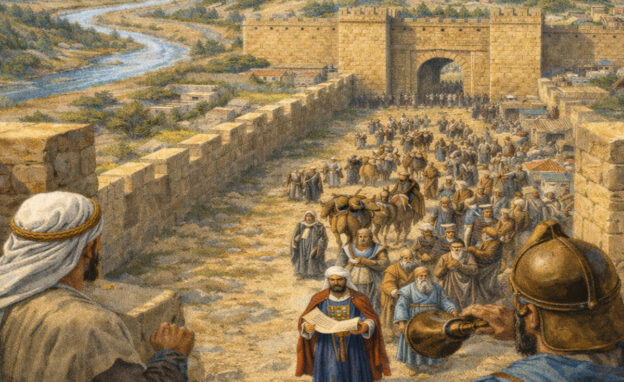
In the meantime, Ezra finally arrives on scene in chapter 7 of Ezra, both literarily and literally. These first ten verses give us an indication of who this man is, why he has come to Jerusalem, and why God has chosen Ezra for his mission. We see a snapshot of Ezra’s credentials, Ezra’s commissioning, and Ezra’s compulsion. In this snapshot, we see a glimpse of Christ’s same mission, and in Ezra’s conduct a pattern for our own out of a thankful desire to please God.
Nearly sixty years pass between the end of chapter 6 and the beginning of chapter 7. At the end of chapter 6, a group of exiles had returned. They had rebuilt the altar, endured twenty years of oppression and resistance, rebuilt the temple, resumed worship, and celebrated God’s goodness to them. All must now be well, right?
Sadly not. The years rolled on. Praise became pattern. Rejoicing became expectancy, and then complacency. The hard lessons of exile and loss were not passed on. Even God’s deliverance of his people through Esther and Mordecai did not stop the decline. And so, reformation had to come again to Jerusalem. And thus, Ezra arrives on scene.
Ezra was descended from Jews who had stayed in exile, when the first hardy exiles returned. Some of the priests and leaders of the Jews would need to stay, to ensure that the Jews who remained were led and guided in how to worship God in a strange land. Ezra’s grandparents were in that band.
The first five verses of chapter 7 give a genealogical background for Ezra. While for most of us that is yawn inducing, unless we like to dabble in ancestry websites online, for Ezra’s day and culture it was extremely important. It introduced Ezra’s credentials to lead.
Ezra’s credentials were significant. Ezra’s priestly line goes back to Aaron (vv.1-5), through Zadok the priest (who anointed Solomon), Hilkiah who served during Josiah’s reforms (2 Kings 22), and Seraiah who served when Judah fell. While he was not the high priest himself, Ezra’s ancestors hit all the right notes of Israel’s worship. He was not someone to casually dismiss.
Yet why had Ezra come? The answer was that he was commissioned. Ezra “was a scribe” which marks him out as a trusted government official, who was also “skilled in the Law of Moses that the LORD… had given” (v.6). It seems that he was sent by the Persian King, perhaps to report on the situation there, by Ezra’s own request. But this was “for the hand of the LORD his God was on him” (v.6). King Artaxerxes may have sent Ezra, but it was God who commissioned and sent Ezra.
Yet the text also indicates that Ezra wanted to go. So what compelled Ezra to leave Babylon’s comforts and return to Jerusalem? It was not an easy trip, taking four months (v.8), along with “some of the people of Israel, and some of the priests and Levites, the singers and gatekeepers, and the temple servants” (v.7). Dangers from nature and bandits lay along the way.
The answer is that “the good hand of his God was on him” (v.9), because “Ezra had set his heart to study the Law of the LORD, and to do it and to teach his statutes and rules in Israel” (v.10).
Ezra was a reformer. He had been captured by God’s goodness and grace, and delighted to learn how he could please God, and to pass that on to God’s people in Israel, starting in Jerusalem where God’s temple sat.
Ezra was not in it for the money. Ezra wanted God’s glory. Ezra wanted God’s people to live in ways which honoured God. It compelled him.
In Ezra, we see a picture of Jesus. If Ezra is pictured here as credentialled, commissioned, and compelled for God, how much more is Jesus! Ezra traced his line to Aaron through Zadok. Jesus’ line traces to Adam through David. God sent Ezra through the Persian King, but spoke publicly to commission Jesus as his beloved son in whom he was pleased! And Ezra delighted to learn God’s Law, but Jesus not only embodied it but fulfilled it for us, in his life and his death for our sins on the Cross.
Because of Jesus’ success in his divine mission, we are lovingly restored to God’s presence in his church. Like Ezra, captured by God’s goodness and grace, we have the privilege of learning how to please and thank God by following his commands, and are compelled to faithfully hold Scripture’s truths as a new generation.
Because Jesus, like Ezra before, arrived on scene.