
Oh great, another list. While lists and charts may tickle the fancies of us who like to put ducks in a row and administer things smoothly, it is hardly the most enjoyable reading. In the Bible, it is a tempting target for a bounce to the next section (come on, confess, you all have at least considered it). What does another list have to do with helping me grow to become more like Christ?
The answer is in the details. There are subtle pieces of information that teach us about how God was still working out his plan of salvation. Whether it is family groups, passing references to identities, or the number of families who returned with Ezra, Ezra’s meticulous record keeping and diarising is not just intended for the appendices to the Scriptures but to point us to Christ.
This section of Ezra is written in the first person. It may reflect the personal diary of Ezra the government official, recording what he did and why. As a servant of God, it serves the same purpose. And because it is in the Bible, it was written for our benefit.
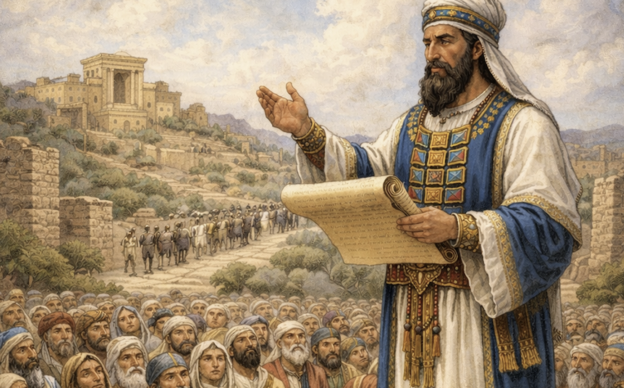
In a culture, largely unlike ours, which put huge value on family lineage, the list records “the heads of their fathers’ houses, and … the genealogy of those who went up with me from Babylonia, in the reign of Artaxerxes the king” (v.1). Ezra recorded this because it gave weight to who returned.
It also showed, when compared to the first returnee list in Ezra 2, that all but one (Joab’s family, v.9) were following after the first pioneers. Families had divided over whether to stay or go. But clearly, lines of communication between the family groups remained open over the decades. The group who returned with Ezra would have learned of the progress and spiritual condition (or lack of it) in Jerusalem. They went to join their family members who had gone before them.
We also note that two priestly families returned. They are listed first, as sons of Phineas and Ithamar (v.2). We do not know why these priestly sons remained in the first place, but perhaps they were serving the Jews who remained in Babylon. Eventually, the call for them to leave and return came to them too.
There is also a son of David, Hattush, who returned (v.2). Whether Hattush sits somewhere in Matthew’s genealogy of Jesus, which may have skipped generations, is not known. But it does further show God’s favour to the line of David which, despite not having a king on Judah’s throne for more than a century, was still continuing on quietly until Jesus came.
And what of the other names in the list (vv.3-14)? They represent a cross section of the Jewish people. Specifically, twelve families. That is no mistake. Twelve tribes. Twelve disciples. Twelve families. God is sending a message about his people in Ezra’s list. God was still working to preserve his complete people.
And speaking of completeness, the sons of Adonikam “those who came later” also appear in this list (v.13). The phrase quoted can also be translated “the last ones”. While we cannot say for certain, this may refer to the remainder of an entire family line who followed Ezra from Babylon to Jerusalem, reunited with their brothers in Judah.
This listing is not an accident. It was placed here on purpose. God is telling us how he is working his salvation plan out, even in the little pieces of migratory movements. He is also reminding us of what is truly important.
Whether or not the number is larger (as in Ezra 2) or smaller (as here), God is working to save and preserve a people for himself. He is calling people from exile to his presence, to serve and worship him.
This list also gives us a cultural check. In our culture, youth is idolised. Everyone wants to look young. Sometimes it feels like everything is catered to children, including the way some churches focus their strategy for evangelism. But the Bible looks at it the reverse. Perhaps we have missed something.
We should never neglect our children, who are important and valued gifts from God. Nor should we forget it is the home, particularly the Christian home, and the pulpit, that are where our children are properly formed. They cannot be formed if they are not well led by their parents, and especially wherever possible by a husband and father pursuing godliness in his personal life. As one myself, I pray that God would shape me in godliness as a better husband and father every day. This is something all of us can pray for, whatever our circumstances.
We can trust that faithful, patient Christian formation in the home and from the pulpit works because of God’s promises. And we can trust God’s promises, because even in this passage, God kept his promise to bring home exiles, and preserve David’s line. So in time, our Saviour and King Jesus, would come and bring us safely home to God’s presence.