Where do you seek wisdom from? Today we have the internet and AI and Proverbs feels so random. As we enter the Proverbs proper, we’re going to use the introduction of Proverbs (Pro 1:1-7) to guide us, and Genesis 3 as a case study to explore what God (through Solomon) is trying to tell us about the foundations of our faith.
We’re going to get insight into what went on in the Garden of Eden and that fateful moment when Adam and Eve were tempted to sin. We’ll get lessons in God’s righteousness, justice, equity and wise dealing, but we won’t take them at face value.
We’ll ask God the tough questions: was He fair? Why did He let this happen? We’ll see the Proverbs speak to His plan for humanity, His Wisdom, and His great love for us.
Passages: Proverbs 10:1-17, Genesis 3, Proverbs 1:1-7, Mark Harrison, Sunday 14th December 2025
Sermon recording
Rerecording of the original is below with better pacing.
Seek wisdom, avoid injury, and obtain life and favour from the Lord
Our passages today: Mat 4:1-11 & Proverbs 9, Preacher Mark Harrison, Sunday 25th May 2024
Introduction
Are you wise? Have you ever really thought about it? Wisdom is something that’s still quietly celebrated even in our culture today. We want to listen to wise people who know the answer and can help us succeed. But what does it mean to be wise? How can one become wise?
To explore this we’re continuing our series in Proverbs: a fascinating and somewhat under-appreciated book in the Old Testament, that is really practical and relevant; it’s where the rubber of faith hits the road of real life, helping us deal with tricky situations where there’s no clear answers. I’m Mark and one of the members here.
Recap
Last time, several months back, we looked at Proverbs 8. A personified woman: wisdom is crying out to everyone to listen and seek her. To the wise, the simple, and the fools opposed to God. She’s offering an “inheritance to those who love” her “better than Jewels and all you may desire”, “riches and honour” are with her. As Josh mentioned last week: who wouldn’t want riches and honour? So how do we get this?
Well, first we asked: what is wisdom? Our basic definition is that “Wisdom is knowledge in context”. And I return to the great illustrator Jez Tuya who once quoted: “Knowledge is that a tomato is a fruit, wisdom is knowing not to put it in a fruit salad”
And then we asked who wisdom is, because there’s more going on than ‘knowledge in context’, if you look at C8 and v22-31: she’s as old as the Earth itself, she’s described as a “master workman” beside the Lord, there “before there beginning”. Think of the creation narrative and the beginning of John’s gospel – the language is so similar. And hence a lot of people have said Lady Wisdom is Jesus: after all the Bible says Jesus the “Word of God” present since the beginning.
But as we saw that doesn’t fully cover the message of Proverbs. Because Wisdom also stands as an attribute of God; something Christians should seek every day as part of their “walk with the Lord” to obtain life and favour. Many of us are simple Christians without much wisdom; vulnerable to spiritual injury and even death.
Overview
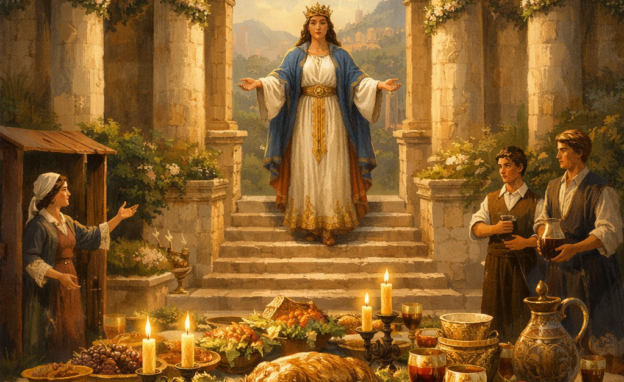
And our passages today follows on from this: illustrating the stark choice between wisdom and folly. Both offering a feast with a very different menu – Will you feast with Wisdom? Or risk Folly’s temptations?
Let’s look at our passage: helpfully divided into three sections for us in the ESV version:
Wisdom’s invitation v1-6
Wisdom’s feast v7-12
Folly’s invitation and feast v13-18
1. Wisdom’s invitation (v1-6)
We’ll start with v1: picture wisdom’s house that she’s built with with 7 pillars which she has “hewn” or made. It’s a grand house. Some have said the 7 pillars represent the 7 aspects of wisdom mentioned in proverbs: instruction, knowledge, understanding or insight, discretion, counsel, and reproof – all characteristics of wisdom. 7 generally symbolises perfection in the Bible, and I think that’s the main message here. This is the perfect Wisdom of God.
She’s taken the time to prepare and done everything required for her perfect feast. Notice in v2 there’s a large amount of meat from freshly slaughtered animals, and wine that has been mixed.
This isn’t just popping down to the local supermarket and getting a kilo of mince: in the old times, slaughtering animals was a big occasion. Wisdom here has multiple animals; it’s a lavish feast. And wine will be served with the meat: so there’s alcohol too.
Alcohol in Christianity
Now Some of you may be thinking: is it wise to be having alcohol? A good number of Christians avoid alcohol because of the issues with drunkenness and sin, and there’s merit in this approach. The apostle Paul lists drunkenness as something to avoid in Gal 5:21. But there’s no rule against drinking alcohol in the Bible. For instance: In addition to animal sacrifice, God accepts wine as a drink offering in Leviticus (23:13), Jesus turns water to wine in John 2 as his first recorded miracle, Paul advises Timothy to drink some in 1 Tim 5:23, the Kingdom of God is likened to a vineyard in Mat 20:1-16. And Pastor Ian has planted a vineyard…and their wine is very good too.
So how then can the Bible promote something that can lead to drunkenness and sin as a good thing that “gladdens the heart”? The answer’s right here our passage: moderation! Wisdom offers wine in moderation, and this is because she mixes it.
Moderation
Yes I know, mixing wine isn’t very common today – you wouldn’t tip a fine bottle of Pinot Noir into a dodgy Chardonnay. That’s not what we’re talking about!
In ancient times people drank a lot of fermented drinks because they were safer than water, and the wine was very bitter and had a high alcohol content! You can see where this is going!
Mixing with fresh or seawater was both the cultured thing to do for taste, but also for moderation. Drinking still or undiluted wine was “barbaric” according to the Greeks. In the story of the Iliad, just three glasses of undiluted wine are enough to get the giant cyclops drunk – strong stuff.
So this is a deliberate and thoughtful thing to do, a wise thing to do(!): she practices what she preaches.
And this is a lesson for us – the wise way forward is often to reject the poor choices put before us and find another option. For instance, I was recently presented with an issue at work where a process was failing due to insufficient user permissions. I was presented with options to either grant full access to the users which would compromise security, or have the process run anonymously as admin but then we couldn’t tell who was doing what. The answer was neither of these: what we needed to do was copy the small piece of data needed into a place the user could access it. Going back to the root of the problem and what we were trying to resolve was key. We needed to mix or moderate the requirements and find a wise solution.
Wisdom’s call
In our passage, Wisdom has pre-empted the problems and put a lot of effort into the feast, and also into the invitation: she doesn’t want to dine alone. Her servants are in the town calling from the highest places where their message will have the most impact. She is actively out there seeking people.
Remember Proverbs 8:1: Wisdom herself was calling out from the highest places. Now she’s enlisted all her messengers to call to us as well!
In our passage v4-6:
Proverbs 9:4-6 ESV
“Whoever is simple, let him turn in here!” To him who lacks sense she says, [5] “Come, eat of my bread and drink of the wine I have mixed. [6] Leave your simple ways, and live, and walk in the way of insight.”
This is an ‘all hands on deck’ moment – Lady Wisdom is out there herself with all her messengers, pulling out all the stops to spread the word. If so much effort is going in: what is so important about this feast?
Why so much effort? (Nature of wisdom)
There are plenty of clues but let’s take a non-obvious detail: look at the description of her messengers as “young women” in the ESV. A random detail? Is anything in the Bible random? What does it tell us? “Young” gives us contrast with the ancient lady herself: she’s as old as creation.
Being female is possibly a reflection of the culture for a noble lady at the time – there’s no impropriety.
Fair enough, but have you wondered: why is wisdom female? We know that Male and Female represent a complementary relationship in the Bible. So Wisdom being female brings to mind the complementary relationship between God and His attributes, God and Creation, husband and wife, Christ and the Church. It is a “profound mystery” as Paul says (in Eph 5:32) as he makes the point that God is modelling human relationships on his own relationships; including that of the church being out there proclaiming that Christ has risen from the dead!
It’s a point made throughout the passage: Wisdom and God are intimately related so we should take notice, you can’t have saving faith without some wisdom, and wisdom could well save your faith.
So this message is an important message from God: firstly the simple should come, that there’s great food and drink on offer. And if that wasn’t enough, we’re implored to “leave [our] simple ways and live”!
Look at v5:
Proverbs 9:5 ESV
“Come, eat of my bread and drink of the wine I have mixed.
Where else do we have bread and wine? In church: for communion. Why? And what does it remind us of? Well, Pastor Elimr stood here four weeks ago breaking bread and proclaiming God’s salvation through Jesus: his blood shed for us, his body broken: the penalty of our sins on Him. And why is this so important? Because without Jesus there is no forgiveness for Christian sinners, no relationship with God, only eternal death.
Why are we invited?
But why us? What have we done to deserve this invite? Nothing! Isa 64:6 says even “[our] righteous deeds are like [filthy rags]” to God. We don’t deserve it. This is love, pure love from God:
“For God so loved the world, that he gave his only Son, that whoever believes in him should not perish but have eternal life.”
John 3:16
This free and open invite to salvation because God loves us is so unique to Christianity, so humbling and amazing:
This is far far more than friend’s dinner party or a “Come Dine With Me” experience; this is a carefully prepared, life-saving experience for everyone!
So what are we waiting for?! Let’s see what wisdom has to offer.
Wisdom’s feast
V7-12: On the menu today we have four courses. Starting with a selection of entrees:
V7-8 Avoid sharing wisdom with fools
V8-9 The wise seek more Wisdom
Then the main course:
V10 Jesus is the foundation of godly wisdom (1 Cor 3:11)
And for dessert:
V11-12 Godly wisdom will keep you from harm (cf 8v35-36)
What a feast! Everyone ready?
Let’s read from v7:
The wise seek more wisdom: personal seeking and taking feedback gracefully
Proverbs 9:7-9 ESV
Whoever corrects a scoffer gets himself abuse, and he who reproves a wicked man incurs injury. [8] Do not reprove a scoffer, or he will hate you; reprove a wise man, and he will love you.[9] Give instruction[b] to a wise man, and he will be still wiser; teach a righteous man, and he will increase in learning.
v7-9: is offering both instruction and test for personal validation. Are you wise? Perhaps I’ll put it another way:
Do you love those who find fault with you, and graciously accept their feedback?
From your wife, or husband, your children, friends, or colleagues? Yes, it’s difficult.
None of us are perfect and we all need correction to improve. Whether that correction or feedback is constructive and given in love or not, even when it’s given in the heat of the moment with with the wrong motives – it’s still feedback and there’s still something to learn – we shouldn’t get offended and say: “oh I don’t need to listen to this” “ they did X which is much worse”, “they’re just being silly I know better” – do you? How much do we see this attitude around us? How many times do we think this ourselves?
Of course we have to be careful in how we interpret the feedback (and seek counsel from a wise elder if unsure), but the passage is saying we should give feedback and receive it gladly to encourage one another. Wisdom is starting with this point to set some really important ground rules: being teachable is at the heart of wisdom: A stubborn fool can’t become wise. So hence we should always be seeking to learn.
Giving feedback: we can’t change others
Unfortunately, while we have a choice to accept feedback ourselves, the passage notes that we can’t force others to do so.
V12:
Proverbs 9:12 ESV
If you are wise, you are wise for yourself; if you scoff, you alone will bear it.
Because Wisdom is a personal choice. We can help guide others but it’s not guaranteed, and further: if you do try v7 gives a strong warning: trying to reprove a scoffer will result in abuse or injury.
I’ve seen this countless times and it’s really important to identify who you are dealing with and when. If someone doesn’t want to listen, there’s no point engaging and arguing: for people who have made up their mind: it doesn’t matter how good your reasoning is, some are even just trying to use what you say against you. It’s best to not engage, as best you can to avoid injury.
Did you notice wisdom’s public invitation in vv3-6: her message is to the wise and the simple, but not to the mockers and fools this time; because of what she’s about to share.
Be careful with the Gospel
You see: we need to be careful with wisdom and especially gospel wisdom
Jesus elaborates on this in Mat 7:6:
6 “Do not give dogs what is holy, and do not throw your pearls before pigs, lest they trample them underfoot and turn to attack you.
It’s worth looking up the context of this verse: Jesus has just called believers to : “take the log out of your own eye before commenting on the spec in your brother’s eye”. And then V6 then goes further saying if that person is not a brother, then don’t even offer the pearl of wisdom. Because the foundation of wisdom, the gospel, is folly to unbelievers and they are liable to go on the offensive.
To illustrate this i was reminded of a recent news article where a plane passenger was watching a raunchy adult film on a long-haul flight and received a note from another passenger saying: “You are a sinner. Repent and turn to Jesus”. Proverbs would suggest this is not a wise way to approach a non-Christian. In the article the non-Christian was quote “appalled” by the note and carried on watching the film anyway. Owch! Perhaps a wiser approach would have been to appeal to their sensibilities: for instance if there’s a child able to see it, or just ignore it and block up the gap with an extra pillow! In order to share the gospel, maybe try getting to know the person first, is this ‘sin’ really the most important thing you can help them with?
Personally, I find 1 Cor 5:9-12 really helpful in dealing with these situations. Paul writes:
9 I wrote to you in my letter not to associate with sexually immoral people— 10 not at all meaning the sexually immoral of this world, or the greedy and swindlers, or idolaters, since then you would need to go out of the world. 11 But now I am writing to you not to associate with anyone who bears the name of brother if he is guilty of sexual immorality or greed, or is an idolater, reviler, drunkard, or swindler—not even to eat with such a one. 12 For what have I to do with judging outsiders? Is it not those inside the church whom you are to judge?
Paul’s key point is that we are to hold Christian “brothers” (and sisters) to a different standard than non Christians. Because a non-Christian’s primary sin is idolatry (not worshipping God alone) and the rest follows on from this.
They are missing a firm foundation: the belief in God and acknowledging Jesus as Lord. V10:
Proverbs 9:10 ESV
The fear of the LORD is the beginning of wisdom, and the knowledge of the Holy One is insight.
Yet last time we noted 1 Cor 2 v7:that this is “ secret and hidden” and (v14) not understandable as it is “spiritually discerned.” – it’s seems like “folly to [non Christian’s]”. So don’t be too hard. That’s not to encourage sin, but simply to be understanding.
These passages are saying true wisdom is hidden and explicably linked to faith: we can’t reveal it, we can’t force someone else to come to faith or be wise.
But wisdom can be used to influence and impact others through our speech and conduct, and can be used by God to bring people to a saving faith – so don’t lose heart.
Wisdom is from God: can a non-Christian be wise?
Because For believers, that saving faith in v10 is just the beginning of wisdom. Wisdom with many practical benefits that can help (V11):
For by me your days will be multiplied, and years will be added to your life.
Proverbs 9:11
Because wisdom helps us make wise choices, protects us from harm, and prevents injury as we looked at last time.
So given non Christian’s lack this foundational faith necessary for wisdom, can they be wise? Can a non Christian be wise? By definition: Yes. Wisdom is knowledge in context; sure everyone has some context from their experience, but who provides the ultimate context? God. So it’s a transient worldly wisdom.
Solomon says in Ecclesiastes 1:14 ESV
I have seen everything that is done under the sun, and behold, all is vanity and a striving after wind.
It’s vanity because there’s no anchor, the worldly wise risk being, “simple children, tossed by the waves” according to Eph 4:14.
In Christ we have an anchor, which means Christian wisdom far surpasses worldly wisdom. Think about it:
Firstly it’s leads to eternal life, free from suffering and sin
It allows us to be wise beyond what our experience would allow
You can just ask for it: it’s a prayer away
It’s relational, we’re guided in wisdom by the Holy Spirit who dwells in us
It’s an amazing privilege for holding on and staying true to that anchor.
Throughout Proverbs we see this real tight coupling between fear of the Lord, wisdom, earthly benefit from making wise choices, and spiritual benefit helping us avoid sin, it’s really central to a strong and sustainable faith.
Application
But there’s a real trap here interpreting this passage that we need to be aware of. It’s easy to think that these charactures of the wise, the simple and the fool are labels for individuals we may meet: “Wise Christians” and “foolish non-Christian”, but this fails to grasp the deeper point that Wisdom is making.
Think about what we’ve looked at: Wisdom is a personal virtue, we are wise for ourselves: we know ourselves, but we don’t know for certain who are Christians and who aren’t, we don’t know their inner hearts like God does. Therefore, how can we label anyone else wise or a fool?
Because Wisdom is the foundation of our personal faith and she’s set us a challenge to continually seek her (8v34): you see: Wisdom’s intent is that we should be applying this passage a lot closer to home.
For instance: would you consider yourself wise all the time? I know I’m not. And I think of arguments and I see verse 7 in action – was I open to listening? Was the other person? No: injury was incurred, you can’t reason with a fool. Even two Christian fools who in that moment are opposed to God by failing to respond in love.
And this is how proverbs operates: there’s a general observation and a specific application; we can think of the fools, the simple and the wise as three different stereotypes, that people outwardly display, but also within ourselves.
And this is why Jesus’s offer of salvation is renewed every morning (Lam 3:23), because we are all foolish sinners.
So hence the application of v7-9 is not so much who we’re dealing with, but what we’re dealing with; not everyone is wise or foolish all the time. Even “ a stopped clock is right twice a day”. We have to discern the situation and the interaction rather than the person themselves, and remember to take the log out of our eye before removing the spec from a brother.
Because Jesus came to save the foolish; by providing a foundation of wisdom so that we might know the truth: that we are imperfect and need his saving grace. This starts at home with ourselves.
His offer of salvation is for anyone to accept; same as wisdom’s feast. The simple can turn in, the fools can learn sense (8:5)
While, we can and should expect sin from other humans, (and note: it hurts!) Wisdom can help us deal with this. What we really need to focus on is our personal wisdom and walk with the Lord. This is the challenge for each of you today: will you respond like the wise man in verse 8? Will you respond with love to those who reprove you?
Because even the wisest amongst us has more to learn.
So are you satisfied with Lady Wisdom’s feast? We’ve seen how:
Jesus Christ is the foundation of Wisdom and
It’s personal and needs constantly renewing
To keep us safe from harm
Yet we need to be careful with how we share it
Being simple by ignoring this message risks spiritual ‘injury’ and death. This is what the remainder of our passage warns us about.
Folly’s invitation and feast
As we now meet our alternative host for the evening, because there are two dining experiences in town! You have a choice, you don’t have to take Lady Wisdom’s offer. Madame Folly is happy to invite you in.
We’ve left this section to last because our passage has left it to last. We know enough about wisdom to see the alternative for what it really is:
Folly is “loud” and she “knows nothing” – this whole section is a striking contrast to v1-6. She is “Seductive”, this is the same caricature of folly in C7; as an adulterous woman. It’s Amsterdam at night: there are all sorts going on, and we shouldn’t miss the motive for this imagery. As Pastor Ian noted in our studies on the book of Romans: “sexual sin isn’t the worst sin, but often the first sin that appears in the absence of truth” as it’s a sin against ourselves. Sexual sin is used throughout Proverbs 1-9 as both a direct lesson, and also a metaphor for other sins: it invokes the emotions of temptation and entrapment – because this is what sin is like. It draws you in, just a little bit, and the path out of it gets harder and harder.
And Folly’s message seems to be effective, she has no servants; doesn’t need them. She doesn’t need to even leave her door. She’s done no preparation, and the meal on offer is very simple meal: bread and water.
Bread was the basic staple at the time: it’s just enough to survive. And it’s stolen – it’s not even hers! She’s committed a crime and said, “come and join me in my crime”: so if you eat that bread knowing this, you are stealing too! And once a criminal, she can blackmail you, and it’s no wonder that v18 shows many never leave:
The exit is difficult, and many don’t make it. Lev 6:1-5 notes the exit requires admitting guilt and paying reparations for what’s been done. So many don’t make it.
And then…our passage ends abruptly. The author of Proverbs is showing us the abrupt end of this path: the finality of it. Folly’s feast is a trap!
But, come on! you may be thinking: Stolen bread vs fine meat? why would anyone go in? You don’t have to be Sherlock Holmes to figure that one. But why is Folly’s message so effective? Why are there so many guests in v18?
And this is the trap: trivialisation of folly. Society tends to think that being foolish is lighthearted and something silly, like a clown outfit that’s amusing but can otherwise be ignored. Yet our passage teaches that it’s deadly serious and leads to death.
That still doesn’t answer the question: How can someone who “knows nothing” be so effective with their invite?
There’s a couple of hints in this section that something more sinister is going on. Notice that:
Folly’s at the entrance to her house, but is also in the highest places
She’s managed to place herself in the middle of the paths
Her guests are in sheol, or the grave
That she “knows nothing”, but has managed to get a house or seat at the “highest point in the city” to somehow intercept people going straight on their ways, to invite them to a feast leading to the grave, hints at her identity as doorkeeper, an agent, even ‘attribute of’ the main opposition to God.
Discerning folly
And now our two true hosts for the evening are revealed: Lady Wisdom, an attribute of God, against who? in our NT example (in Mat 4:1-11) We see the master temper himself in the epic battle of wisdom against folly. And now we know who is pulling Folly’s strings, we can see just how dangerous a threat folly and her master are when Jesus was tempted in the desert. If he had failed, there would be no salvation for any of us.
Let’s take a brief look at what happened in Mat 4:
It’s Right at the beginning of Jesus’s ministry: he’s led into the desert by the Holy Spirit: This is God’s plan to prepare him for ministry. He’s hungry, there’s physically not a lot to do, and His mission feels far removed.
Commentators reckon he had water, would have slept, and prayed a lot to prepare for ministry, but 40 days alone in the elements would have been a very testing time.
If any of you have watched the survival series “Alone” those that pass the 40 day point are the serious contenders for winning, and they’ve all kept themselves busy, and caught and eaten something to get there. But Jesus had no food at all.
Into this, the tempter arrives and he knows the weak points: Jesus “ was hungry”, and likely apprehensive about his mission (we know that he sweat blood prior to going to the cross for us), and the tempter offers shortcuts to meet his physical needs and avoid an agonising death on the cross.
This is where we need to be careful: it sounds logical, it sounds like “wisdom”, a bit of friendly advice to someone in a jam? But it’s not Godly wisdom! It’s twisted, like the words in Genesis 3 when the woman is tempted by the serpent in the garden to eat the forbidden fruit. “Did God really say you should not eat from any tree in the garden?”
He uses our physical desires like turning rocks to bread, love of money or desire for status
He uses things that we know are good twisting them, like the temple, sex, and positions of authority
And He even uses our faith taking scripture out of context “he will command his angels concerning you” – and how many false teachers have led people astray.
But note: Jesus resisted, he used scripture in context, and the tempter left him. We can also remember James 4:7: “Submit yourself therefore to God. Resist the devil and he will flee from you”.
Now we’re not Jesus, so our temptations are unlikely to be on such a grand and vivid scale, with God’s plan for humanity on the line, but the personal battle is just as important for us: our salvation is at stake.
We need to take this warning against folly seriously – she is subtle and manipulative, because her master is clever and cunning. Godly Wisdom, Prayer and the Holy Spirit are needed to resist them.
Application
So to summarise, three points:
Like salvation, wisdom is personal
We can seek wisdom through prayer, scripture, good fellowship, and above all being teachable.
In that: we should help teach others, but be careful
Lest you suffer injury. Use the charactures as a guide, but also people’s responses. Are they responding well? Continue. Are they not? Then leave them and pray.
And be vigilant and resist folly
As Jesus did at his weakest moment, no matter how logical and appealing folly can be, we need to hold on to true wisdom.
Conclusion
So today, whether you’re a Christian or not you’ve hopefully seen the wisdom present consistently throughout the Bible, throughout many different authors over thousands of years: Old Testament and New. A message of relationship, joy, and love from God who is calling out to you. This is Wisdom, and her call (v5): “leave your simple ways and live”.
A lot to consider: there is a take home summary at the back and it will be available online for a time. Thank you for listening today. Let’s pray:
Closing prayer
Dear Lord, thank you for the time you have given us to come together and hear your word. We pray for those that don’t know you: that you will provide understanding of the truth behind the world we see; that all is created for your glory, and you love us such that you would die for us.
We pray for Christians: that each of us would not be satisfied with the foundational spiritual milk alone, but crave solid food, wisdom, and a meaningful eternal relationship with you. Thank you for your great mercy, grace, and love for us. Amen
Last week we started the year with regrets and aspirations. This year there seems to be a lot more going on in the world that hasn’t previously been going on such as wars and rumours of wars.
Our fallen world
We are in moral decline in the west with Christian values being torn away. We’re disappointed also in ourselves when we participate in it.
The world is ruled more obviously by different tyrants who have got into power and lead by fear and persecution.
Neither socialism or capitalism can contain the true heart of man, which sees what we can get at the expense of others.
We see democracy dying as it carries the seeds of its destruction.
Our sovereign Lord
Growing up in the post Second World War: the Cold War. The button for nuclear war was ready to be pressed.
My dad took me aside and said: I believe God is sovereign over all the world and everything that happens is by his permission. I found this comforting.
The one enthroned in heaven laughs; the Lord ridicules them.
Psalm 2:4 CSB
Some will say it’s the devil at work, but he’s also restricted by God.
Psalm 2 reminds us of God’s Son: Jesus. Jesus lived, died, rose again and was raised again. He commanded his disciples to go out:
And Jesus came and said to them, “All authority in heaven and on earth has been given to me. [19] Go therefore and make disciples of all nations, baptizing them in the name of the Father and of the Son and of the Holy Spirit,
Matthew 28:18-19 ESV
Jesus has all authority, which includes both giving life and judging others.
Worship him with fear and trembling
Our response should be to bow down and worship the Lord with reverence.
Now therefore, O kings, be wise; be warned, O rulers of the earth. [11] Serve the LORD with fear, and rejoice with trembling. [12] Kiss the Son, lest he be angry, and you perish in the way, for his wrath is quickly kindled. Blessed are all who take refuge in him.
Psalm 2:10-12 ESV
We’re to worship him with joy and with fear and trembling.
When I was in my teens I leased a large block of land and became a farmer. Canterbury in 1975 had a great storm, and almost every tree was broken or blown down. In those days farming didn’t make much money so to supplement my income I chopped wood.
There was a tree I was cutting down which was at a precarious angle and I needed to get underneath to cut it. I thought I could cut and get out of the way of it started moving. I was underneath and cutting it – I went all the way through and nothing happened. I stepped out and kicked the tree and out instantly fell – I felt the air around it – there was no way I’d have been able to run from under it. It was a narrow escape from death. I rejoiced with joy and trembling.
There’s wars and rumours of wars but we should take comfort that nothing happens without God’s express permission.
Our passage today: Luke 2:21-38, preacher Ian Bayne, Monday 25th December
Jesus is just 8 days old and met by the priest to be circumcised.
When they came there were two individuals that met them: Simeon who was waiting for the Lord.
Anna was 84 years old, also in prayer and connection with God. When Jesus is presented, she recognises Him as the messiah.
1. The Lord was looked for
Some who had read the Old Testament new the messiah was coming as a son of David who would redeem Israel (believers).
At our house Christmas isn’t really my thing, tripping over bears on stairs, but I do really enjoy watching the anticipation of the children.
Back when I was growing up there was an old sock and an orange in the bottom of it, things were more meagre, but still exciting. You didn’t know what would be in the sock.
There was an anticipation for Jesus.
2. The Lord was prepared for
Simeon and Anna were praying for Jesus. They receive encouragement and prayer.
Sometimes people ask me what I do and I say “I’m a pastor”. Sometimes people will then ask “But what do you really do?” I say “I prepare people to die well”
For to me to live is Christ, and to die is gain.
Philippians 1:21 ESV
It’s said that the two most certain things in the world are death and taxes.
3. The Lord came for a reason
He saves us from our sin. The Lord promises to save us from the penalty of our sin and the power of our sin. It can be a slow process, but through persistence and prayer he will help us overcome our sin that he pays the penalty for.
4. The Lord was spoken for
Simeon and Anna both speak about Jesus. Christians don’t want to stop talking about Jesus and want to share the good news with our families and friends.
In spite of what we’ve done and who we are we know and believe that Jesus came as a baby, lived, died and ascended into heaven, giving the Holy Spirit to us to help us live day by day to speak the word to others around us.
It can be hard for others to hear all the time and we hope that one day they will receive the words of Jesus as we received them.
Truly, truly, I say to you, whoever hears my word and believes him who sent me has eternal life. He does not come into judgment, but has passed from death to life.
Life can seem unfair when working hard and missing out on a deserved reward. In this passage Jesus shows God (as a vineyard owner) giving the same reward to each person regardless of how much they work. How is this fair? Ash Clarkson explores this seeming biblical injustice to reveal a God who knows far more about our nature than we do!
Our passages today: Psalm 80:8-19 and Matthew 20:1-16, Preacher Ash Clarkson, Sunday 24th December.
Introduction
This seems a strange passage for Christmas Eve. What does an eccentric businessman have to do with Christmas?
Christmas is a time of gift giving and the birth of our saviour. It’s not based on our own labour or our possessions; none of which translate to our heavenly reward. We’re receive eternal life regardless of whether we come to Christ early or in the last hour of our life.
The workers in the vineyard receive the same reward and grumble. Everyone receives at minimum what they deserve and some got more. There is no place for jealousy in God’s kingdom. Everything he gives us is out of his generosity and we deserve nothing.
Context of our passage
We come to the parable after the story of the rich young ruler who was told to sell all he had.
When the disciples heard this, they were greatly astonished, saying, “Who then can be saved?” [26] But Jesus looked at them and said, “With man this is impossible, but with God all things are possible.” [27] Then Peter said in reply, “See, we have left everything and followed you. What then will we have?”
Matthew 19:25-27 ESV
Some of the disciples were businessmen who had family businesses. Levi was a tax collector who had been taking some on the side before he came to Jesus.
Jesus said to them, “Truly, I say to you, in the new world, when the Son of Man will sit on his glorious throne, you who have followed me will also sit on twelve thrones, judging the twelve tribes of Israel. [29] And everyone who has left houses or brothers or sisters or father or mother or children or lands, for my name’s sake, will receive a hundredfold and will inherit eternal life. [30] But many who are first will be last, and the last first.
Matthew 19:28-30 ESV
Our passage explained
Labourers for the vineyard
Our passage of the vineyard then takes place. The hours were 6am to 6pm and labourers would be in the square at 6am. A denarius was a fair days wage and enough to feed a family.
The day progresses and the labourers who haven’t found work get picked up by the vineyard owner.
From an early perspective what could they achieve in an hour? Very little pay and very little value add; it’s a slightly odd hiring practice.
An odd arrangement?
There’s also slightly odd payment practice:
“You shall not oppress your neighbor or rob him. The wages of a hired worker shall not remain with you all night until the morning.
Leviticus 19:13 ESV
What he does is in accordance with the law, but the amount is surprising:
And when evening came, the owner of the vineyard said to his foreman, ‘Call the laborers and pay them their wages, beginning with the last, up to the first.’ [9] And when those hired about the eleventh hour came, each of them received a denarius.
Matthew 20:8-9 ESV
“It’s not fair!”
Think about how you would feel in each group. The last group would get the equivalent of a denarius per hour, whereas the last group would get a denarius per day.
The workers grumble, setting out through their eyes: it’s not fair.
saying, ‘These last worked only one hour, and you have made them equal to us who have borne the burden of the day and the scorching heat.’ [13] But he replied to one of them, ‘Friend, I am doing you no wrong. Did you not agree with me for a denarius? [14] Take what belongs to you and go. I choose to give to this last worker as I give to you. [15] Am I not allowed to do what I choose with what belongs to me? Or do you begrudge my generosity?’
Matthew 20:12-15 ESV
The Lord’s response
The grumbles are described as friends. This is an address as someone near and dear to him that he cares about.
The disciples are the first hearers of this parable are the disciples. A vineyard is an image of God’s kingdom (e.g. Psalm 80 and Isaiah 5).
The first to follow Jesus gets eternal life and the ones that come after also get eternal life.
We have all gone astray. We’re labourers who sleep on the job and yet he still gives us what we need.
For he says to Moses, “I will have mercy on whom I have mercy, and I will have compassion on whom I have compassion.” [16] So then it depends not on human will or exertion, but on God, who has mercy.
Romans 9:15-16 ESV
Application
The disciples were starting to think that God owed them something. When Jesus was dying there were two men with him. The thief on the cross got his denarius at the 11th hour.
The disciples were not to judge based on their achievements.
Let each of you look not only to his own interests, but also to the interests of others. [5] Have this mind among yourselves, which is yours in Christ Jesus, [6] who, though he was in the form of God, did not count equality with God a thing to be grasped, [7] but emptied himself, by taking the form of a servant, being born in the likeness of men. [8] And being found in human form, he humbled himself by becoming obedient to the point of death, even death on a cross.
Philippians 2:4-8 ESV
The king of all creation was born in a stable, not a palace. His humble birth made the first of all creation last.
Because of the death on the cross we get mercy. When we work hard and we don’t get the gains we say it’s not fair and assume it’s because of sin and that we’ll get what we deserve in God’s kingdom, but the world is turned upside down.
Position and prestige don’t matter, only grace matters. We might think that our lifetime of service might entitle us to something. This is not to deny that there may be different rewards, but it’s all because of God’s grace.
This is liberating: the world is all about being someone, but the kingdom of God it’s not like this. In God’s kingdom, the currency is mercy and grace.
How do we receive God’s mercy? By receiving the call of the landowner to work in his vineyard. Turn to Jesus and follow Him!
God’s goodness and grace is dying on a cross for us.
Today in our classical carol service, we heard about shepherds witnessing a miraculous message from angels proclaiming the birth of Christ the messiah. They were terrified! Their faith led them to leave their fields go and witness this miracle for themselves.
Our passage today: Luke 2:8-14, Preacher Ian Bayne, Sunday 17th Dec
Our passage explained
Normally shepherds would be keeping their flocks. Tonight something special happened: the angels proclaimed Christ as the messiah. The shepherds were “terribly terrified”.
Having proclaimed that Jesus had been born and was in a stable, the shepherds then travelled to see Him. It was an extraordinary event!
1. We find comfort in things that we know.
When we create traditions it’s hard to stop, as we like the comfort. When things happen out of the ordinary things are frightening, especially in the spiritual realm as described in our passage.
Our spirituality has been damaged in the fall (Gen 3), so what we are sometimes afraid of can actually be a message of hope. As an example, we can look to Manoah in Judges; the father of Samson.
There was a certain man from Zorah, from the family of Dan, whose name was Manoah; his wife was unable to conceive and had no children. [3] The angel of the LORD appeared to the woman and said to her, “Although you are unable to conceive and have no children, you will conceive and give birth to a son. [4] Now please be careful not to drink wine or beer, or to eat anything unclean; [5] for indeed, you will conceive and give birth to a son. You must never cut his hair, because the boy will be a Nazirite to God from birth, and he will begin to save Israel from the power of the Philistines.”
Judges 13:2-5 CSB
We know a lot about Samson killing Philistines with a jawbone, and bringing down a great house. Manoah is only mentioned briefly in a passage strikingly similar to our passage today. His father thought he would die from seeing an angel, it was an extraordinary event.
2. What’s irregular can sometimes be a message from God.
Moses was raised up to lead Israel from being a simple shepherd passing a burning bush.
Meanwhile, Moses was shepherding the flock of his father-in-law Jethro, the priest of Midian. He led the flock to the far side of the wilderness and came to Horeb, the mountain of God. [2] Then the angel of the LORD appeared to him in a flame of fire within a bush. As Moses looked, he saw that the bush was on fire but was not consumed. [3] So Moses thought, “I must go over and look at this remarkable sight. Why isn’t the bush burning up?” [4] When the LORD saw that he had gone over to look, God called out to him from the bush, “Moses, Moses!” “Here I am,” he answered.
Exodus 3:1-4 CSB
This was highly irregular and God used it to get Moses’s attention.
3. Joy and praise are natural to the believer
Christmas is like every day for believers. The world celebrates on a day, but Christmas is every day for believers. Every day we remember as John recounts from Jesus’s teachings:
For God loved the world in this way: He gave his one and only Son, so that everyone who believes in him will not perish but have eternal life.
John 3:16 CSB
Joy supersedes every situation, overriding life’s situations. The praise we offer to God provides focus to our situation: that Jesus was born to die, to be raised again and to ascend to heaven for all enemies to be made a footstool for his feet.
If you don’t have joy from Christ the you may have taken a wrong turning, and hence we need to retrace our steps and find that joy again.
In Pilgrims Progress they get captured but escape through the “key of promise” and retrace their steps back to where they went wrong, and further: put a sign up to warn others.
We remember the faith the shepherds had, to go and see Jesus. They had both faith and works which are necessary for salvation:
Senseless person! Are you willing to learn that faith without works is useless?
James 2:20 CSB
4. Faith makes Jesus smile.
Two instances made Jesus smile: first the Roman Centurion:
“Lord,” the centurion replied, “I am not worthy to have you come under my roof. But just say the word, and my servant will be healed. [9] For I too am a man under authority, having soldiers under my command. I say to this one, ‘Go,’ and he goes; and to another, ‘Come,’ and he comes; and to my servant, ‘Do this!’ and he does it.” [10] Hearing this, Jesus was amazed and said to those following him, “Truly I tell you, I have not found anyone in Israel with so great a faith.
Matthew 8:8-10 CSB
And again to the Gentile woman:
But she came, knelt before him, and said, “Lord, help me!” [26] He answered, “It isn’t right to take the children’s bread and throw it to the dogs.” [27] “Yes, Lord,” she said, “yet even the dogs eat the crumbs that fall from their masters’ table.” [28] Then Jesus replied to her, “Woman, your faith is great. Let it be done for you as you want.” And from that moment her daughter was healed.
Matthew 15:25-28 CSB
We need to be reminded of this daily. True faith makes Jesus smile, and offer his salvation to us.
Jesus was born over 2000 years ago and your life will be transformed if you believe in him.
Is boasting always sinful? Paul tells us that it’s not – not when it’s in our Lord and Saviour!
Our passages today Psalm 20 and Romans 3:27-31. Preacher Ian Bayne Sunday 10th December.
Recap
We are all affected by depravity of man which is tainted by sin. The great conundrum is a sinful condition we all share that means we fall short of God’s standard.
Paul has spent the last couple of chapters rounding everyone up so everyone understands they are sinners.
We can’t work our way out. Nothing we can do will save us. Religious duties, sacraments: the Lords supper and baptism, church membership won’t make any difference.
Explanation
There’s one way to escape from the situation: Jesus. The one name given amongst men is the name of the Lord Jesus, son of God.
And I will make enemies Of you and the woman, And of your offspring and her Descendant; He shall bruise you on the head, And you shall bruise Him on the heel.”
Genesis 3:15 NASB
I will raise up for them a prophet from among their countrymen like you, and I will put My words in his mouth, and he shall speak to them everything that I command him.
Deuteronomy 18:18 NASB
Jesus is the fulfilment of the old Gospel. Jesus has achieved everything. Only through faith set alight through God’s revelation
He saved us, not on the basis of deeds which we did in righteousness, but in accordance with His mercy, by the washing of regeneration and renewing by the Holy Spirit,
Titus 3:5 NASB
He took the penalty for us. Only Jesus could be the just and the justifier.
Where then is boasting? It has been excluded. By what kind of law? Of works? No, but by a law of faith.
Romans 3:27 NASB
What can we boast about? Not our works, but our faith in Christ. Boasting is not bad, but it’s what we boast about.
God is a God of everyone. All people, believers and unbelievers will be accountable to him. Faith doesn’t take away from the law and our responsibility to follow his commands. Off we are in him then we ought to do that.
He will grant answers to our prayers and give us victory over our enemies. He will cause us to rejoice. He is sovereign over his creation. There’s no such thing as a Christian without joy.
We’re not always going to be happy: there will be difficult times. He will be our sacrifice and saviour. We may boast in God but not in the world’s currency.
How can humans who don’t know God’s law be held to God’s standard? In this passage Paul explores how ignorance is no excuse and attempting to deflect blame is futile.
Our passages today: 1 Samuel 15:17-23 and Romans 2:12-29. Preacher: Ian Bayne, Sunday 19th November.
Recap
In Romans 1 there were 29 charges levelled at those who reject the truth of the gospel.
This has consequences: a result borne out of those who reject Christ.
We then looked at different types of hypocrites: Paul is gathering in all kinds of sinners and preaching the true gospel to the church at Rome; it’s like an avalanche.
Psalm 139 tells us that God knows our situation and our hearts. This should give us a sense of wonder and inadequacy.
Our passage explored
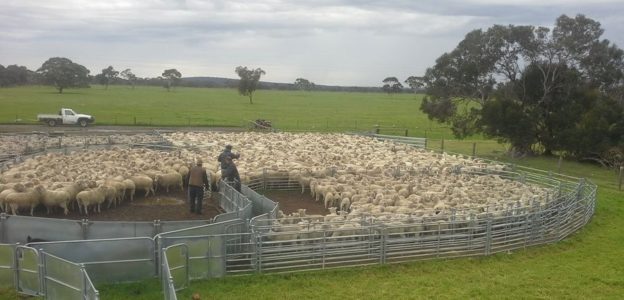
This week I was at the farm gathering my sheep into a pen to invite volunteers to go the abattoir. There were a few holes in the fences, so I wondered if they might sneak out of the pen. I fixed the holes in the fences first! Sure enough, some of the sheep were looking at the previous holes and would have escaped.
Paul starts on the obvious sins, then covers hypocrisy, and now he’s trying to fill in the holes that sinners may try and slip through.
Some years ago we were going to see my sister and heading down in the car. I was getting tired and handed over the driving. The police came up behind and said we were going a bit fast. We thought we were doing the speed limit and didn’t see the sign. But did we still get a ticket: yes we did.
Not seeing the speed restriction sign is not an excuse.
Paul’s point here is addressing the question of how people who don’t know the law need to follow the law. His response is that everyone should know by nature.
Possible responses
“My foot is naturally heavy” the other response is that by nature we are not capable. But God’s law is.
“Im genetically disposed” our race and human state make no difference to God’s law
“Do you know who I am? I’m a son of Abraham” – being a Jew makes no difference, whether we are one race or another or bear the sign of circumcision – it’s not a get out of jail free card.
“It was the woman” – there’s no deflecting to someone else. Adam was held responsible by God.
Ps 139 is about how God sees us. Paul is concerned that we see ourselves as guilty before God and that God is right. As we see here our human condition will always seek ways to avoid responsibility. Paul is trying to help us die to self and put on Christ.
So what does it mean to be wise? Wisdom is a concept that’s often overlooked in Christianity, as well as in the world in general. Our passage makes a great deal of wisdom. What were your thoughts as we read through it? Wisdom “crying out” to us. “Better than jewels and all that you may desire”, and then it goes on to say “The Lord possessed me at the beginning of his work” – invoking imagery of creation and seems to be suggesting wisdom is a person as old as the earth? What’s it all about?
So a really easy passage for a first sermon today, right?
But there is reason for speaking on this passage: it’s a passage that has stood out to me over the last few years since hearing a series preached on Proverbs, and it’s something we don’t hear about very often which is a real practical aid for all of us in our daily lives.
I was keen to explore more about what wisdom the Bible has to offer and share some of this with you today.
Biblical context
It can be helpful to note before we start a little bit about the context of the Bible and where wisdom fits:
Because the Bible primarily guides us in why we should love God (and the wonderful verse John 3:16 is a great summary: “For God so loved the world he gave his only son, that whoever believes in him shall not perish but have eternal life”). We can never love God as we should; without this sacrifice, we would face separation from Him. How can we fail to respond to such sacrifice and love? This is the question the Bible poses.
The Bible shows us how we should respond and love God: with “faith, hope and love” (1 Cor 13:13) and displaying the fruits of the spirit.
Yet, the bible can appear limited from a human perspective on exactly what we do for day-to-day decision-making, and when we should make it: resolving a dispute with a neighbour, or what job we should take. It’s not really what the Bible is for.
Biblical decision making
Of course, big decisions still require answers. Some Christians choose to fill the gap with what they say is being “led by the Holy Spirit” (and while occasionally true, it often means being led by emotion or the first prominent thought (this is like being “tossed to and fro by the waves and carried about by every wind of doctrine” Eph 4:14). It’s very much a human spirituality response.
But what is the Bible’s actual prompt to look to in these situations? What are these folks missing? We’ve just read two passages on it: Wisdom! Wisdom can help us understand scripture, deepen our relationship with God, and be successful in our Christian lives. It gives us guidance with ‘what’ to do day by day: it’s really practical, and really helpful for daily life.
So today we’ll look at what, or who, is wisdom, why we need her, and how to find her.
What is wisdom
Before we start we need a definition: what is wisdom?
Going to the dictionary, wisdom is “knowledge in context” – knowing when to apply the knowledge you have. As the great illustrator Jez Tuya once quoted: “Knowledge is that a tomato is a fruit. Wisdom is knowing not to put it in a fruit salad”
And Proverbs has a lot to say about wisdom! It’s a book of the Old Testament, written by Solomon, a King of Israel around 900 years before Jesus, who was reportedly the wisest man on earth. So he’d know a thing or two about wisdom.
Our passage explored
Let’s turn now to our passage, Proverbs 8, which outlines Wisdom’s final call and is helpfully broken into four sections for us in our Bibles:
Wisdom’s call (v1-11)
Wisdom’s offer (v12-21)
Wisdom’s origin (v22-31)
Wisdom’s challenge (v32-36)
We’ll explore these in turn to unpack the call that Wisdom is making.
1. Wisdom calls (Prv 8:1-11)
Wisdom is calling (v1). It’s Wisdom’s final call! Why is she calling? Why does she need to call? There must be people that need to respond. There must be people that don’t know her.
Wisdom is pictured as a person standing by a crossroads (v2) where people are choosing where to go, she’s at the city gates – which was a social hub in biblical times, she’s at the portals (v3), or some translations have main entrance. You have to be blind not to notice her – Wisdom has positioned herself as obviously as she can and she’s making noise!
She is crying out to everyone. She’s not in a synagogue, or an elite forum, she’s out there in public plain to see. There is no elitism here: wisdom is for everyone in this room and watching online.
Her call is a call to the simple and the foolish if they will listen (v4-5):
“To you, O men, I call, and my cry is to the children of man. [5] O simple ones, learn prudence; O fools, learn sense.
Proverbs 8:4-5 ESV
We learn from the first chapters of Proverbs that the simple are lacking in wisdom and are easily led astray, but the fools are in deliberate opposition to wisdom, and we’ll see later that opposition to wisdom is opposition to God.
A question for you: How does wisdom’s call make you feel? Hazard a guess that it’s probably similar to your reaction to the call of Jesus. If you want to honour Jesus this should make sense. If you’re indifferent, then this could seem “meh”, and if you’re not a fan of Christianity then it can seem inexplicably repulsive – you can’t quite explain why you don’t like it. Hopefully we’ll touch on some reasons for this.
From v6 Wisdom claims to be truthful, righteous and will make intuitive sense to those who are wise (v9): she claims to be better than jewels and all you may desire (v11).
These are bold claims.
2. Wisdom’s offer
In the next two sections we see more about the nature of wisdom, see if her claims stack up and if her offer is a good one.
Verse 12 and 13 tell us a lot about what wisdom is and isn’t:
In v12 Wisdom goes hand in hand with prudence (which is care and thought for the future) – you may hear our politicians talk about “prudent economic policy”, and it’s definitely wise to think about the long term consequences of our actions.
And Wisdom helps us find knowledge and discretion (which is taking care when to act). This aligns with our definition: wisdom is very much about knowing when to apply what we know.
But when we’re seeking wisdom we need to be careful to get the right sort, and use it in the right way, v13 cautions us:
[13] The fear of the LORD is hatred of evil. Pride and arrogance and the way of evil and perverted speech I hate.
Proverbs 8:13 ESV
This is really important and when seeking wisdom we need to be mindful that:
Wisdom is from God
Wisdom is for God
a) Wisdom is from God
Our NT passage helps us understand two types of wisdom. Paul writes in 1 Cor 2:6-8:
Yet among the mature we do impart wisdom, although it is not a wisdom of this age or of the rulers of this age, who are doomed to pass away. [7] But we impart a secret and hidden wisdom of God, which God decreed before the ages for our glory. [8] None of the rulers of this age understood this, for if they had, they would not have crucified the Lord of glory.
1 Corinthians 2:6-8 ESV
He’s saying there’s two types of wisdom: a worldly “wisdom of this age”, and the wisdom of God.
I. Worldly wisdom will fall away
As an example of this:
We’ve been watching “Alone” lately, a TV show where participants get dropped in the wilderness to survive on their own. They create their shelter, find food: there is wisdom on what they are doing: making clay for a fireplace to get better efficiency, using rocks to store heat, building a pier to fish in deeper water.
But the conclusion I’ve come to watching it is that none of the contestants (save perhaps one) really had any chance of surviving the winter. If there wasn’t an extraction team a button press away: eventually they’re going to die. This could be starvation, sickness, loneliness, self-evaluation, injury, and eventually everyone is going to die.
Worldly wisdom can’t ultimately help us. As Solomon says in Ecclesiastes 1:14 worldly wisdom is like “chasing after the wind”. All is “vanity” and will eventually pass away.
II. Godly wisdom will sustain
In contrast Godly wisdom will endure – Jesus says those who follow him will have eternal life (John 3:16).
As you’d expect: Godly Wisdom and God are intrinsically linked. Proverbs 9:10 says:
The fear of the LORD is the beginning of [Godly] wisdom.
Proverbs 9:10a ESV
And Paul refers to Jesus being the “foundation” of Godly wisdom in 1 Cor 3:10-11.
So good news: if Jesus is the “foundation” of wisdom, then every Christian here has some wisdom!
And this is why you’ll notice both here and in our NT passage: wisdom’s call goes unheeded – the world doesn’t respond.
Proud people don’t want wisdom, arrogant people don’t feel they need it, and evil people are opposed to wisdom. A wise person knows to listen and be corrected. So when wisdom calls, when Jesus calls, people have a choice, we have a choice: to be humble and heed it, accepting that we need Him to save us, or be too proud or arrogant to think we don’t need to. It takes a humility to heed the call, and to follow God’s will.
If you do heed the call the remainder of the second section gives encouragement that you’ve made the right choice:
You’re in fine company: kings, princes, nobles rule justly through wisdom (v15-16). There are significant blessings to be gained, as we read in Proverbs 8:18:
Riches and honour are with me, enduring wealth and righteousness.
Proverbs 8:18 ESV
Now you may be thinking: “that’s good, I’ve heeded the call, prayed the prayer and have a bible verse on my bedroom door. Now v18 says I get riches – let’s have a new car!”
Well that’s our second point:
b) Wisdom is for God
Let’s look back at v13: Wisdom warns us that trying to use wisdom to sin, or subvert God’s will isn’t right. Wisdom is from God. You can’t beat the maker at his own game!
A few years back I was unfortunate enough to listen to a sermon preached by another less reputable church in Wellington where the preacher was using bible verses out of context to say “if you want a car, you need more faith; if you want a house you need more faith”.
This ‘prosperity gospel’ is not what Wisdom is about – mindless so-called “faith” leading to untold wealth. But wealth does tend to follow wisdom. Making wise decisions about where we invest our time, resources, and love for the Lord will generally result in his blessing.
So if you really want a new car – seek wisdom. Maybe wisdom will reveal the car isn’t what you really need! Or maybe wisdom will provide a path for you to obtain that car, by the grace of God, through humble obedience and service to the Lord. Or maybe the riches you really need right now are the eternal ones!
From these examples and others, we can see that Wisdom’s call will be heeded by Christians, but not fully by everyone as the final section warns.
3. Wisdom’s origins
Before this, we’ve now arrived at the difficult part of our passage: wisdom’s origin. How we read what or who Lady Wisdom is, will help us (a) trust her, (b) understand what she is saying.
To help us with this I’ll read three well-known passages – can you name the book and chapter?
“The LORD possessed me at the beginning of his work, the first of his acts of old. [23] Ages ago I was set up, at the first, before the beginning of the earth. [24] When there were no depths I was brought forth, when there were no springs abounding with water. [27] When he established the heavens, I was there; when he drew a circle on the face of the deep, [I was there]
Passage 1 – answer below
In the beginning, God created the heavens and the earth. [2] The earth was without form and void, and darkness was over the face of the deep. And the Spirit of God was hovering over the face of the waters. [3] And God said, “Let there be light,” and there was light.
Passage 2 – answer below
In the beginning was the Word, and the Word was with God, and the Word was God. [2] He was in the beginning with God. [3] All things were made through him, and without him was not any thing made that was made. [4] In him was life, and the life was the light of men. [5] The light shines in the darkness, and the darkness has not overcome it.
Passage 3 – answer below
The passages above are:
Passage 1: Proverbs 8:22-24,27 ESV – Evocative language… which may remind us of creation.
Passage 2: Genesis 1:1-3 ESV – Creation
Passage 3: John 1:1-3 ESV – beginning of John’s gospel talking about Jesus
Notice the parallels here – the creation language. There’s something special about wisdom that we cannot ignore – she’s claiming to be God! Some commentaries resolve this by equate Lady Wisdom with Christ – is she Jesus? Others say being “possessed” by God is being part of the character of God. What are we to make of this?
Beside him, like a master workman
We know from our passage that she is with God “besides him, like a master workman”, “set-up” as a foundation of creation, and “rejoicing” in creation and humanity indicating an ongoing relationship with it.
So what is Wisdom’s role in creation? Again we know from the Bible that the persons of God work together during creation with specific roles:
God the Father initiates the creation and provides the Word (Gen 1:1)
The Word of God (Jesus) is spoken throughout creation: he created all things and holds all things together (1 Col 1:16-17)
the Spirit of God is hovering ready to provide life and complete the creation.
Wisdom carries the plan and order. She is logic and rationality that is part of God’s nature, also manifested in the created order. Everything around us has been perfectly created to sustain life – that is the physicality of wisdom.
Jesus is Wisdom personified
So, given the language used and that Wisdom is present and active through Creation, there is a real question over whether Wisdom Personified here is referring to Jesus. People make arguments both ways, but subtly if we flip the question and ask instead: Is Jesus Wisdom Personified? The answer is yes, He certainly is!
Jesus perfectly displays wisdom throughout his life and ministry and is directly referred to as “wisdom from God” in 1 Cor 1:30.
It is because of him that you are in Christ Jesus, who has become for us wisdom from God—that is, our righteousness, holiness and redemption.
1 Corinthians 1:30
Yet you don’t need to have an abundance of wisdom to trust in Christ: little children can know him (e.g. Luke 10:21). You see it’s a start: knowing God is the beginning of wisdom, a “foundation” (1 Cor 3:10) and we’re told to seek more and build on this.
Attribute of God, or personified in Jesus?
So: on the one hand you have Jesus who is wisdom personified and the beginning of all wisdom, and on the other you have wisdom as the plan and logic of God; that the Father, Son, and the Holy Sprit “possess”, and are working alongside. And both are true statements according to scripture. So there doesn’t need to be a debate, we just need to understand this.
Both statement say: Wisdom is from God: we can trust her and we need to heed her call and challenge.
4. Wisdom’s challenge
Wisdom concludes by saying:
“And now, O sons, listen to me: blessed are those who keep my ways… [35] For whoever finds me finds life and obtains favor from the LORD, [36] but he who fails to find me injures himself; all who hate me love death.”
Proverbs 8:32,35-36 ESV
Listen to Wisdom, keep her ways. Seek her and find life and favour.
This is a challenge to Christians who risk injury by failing to find her, and non-believers who risk the eternal death that comes from hating God.
And this is why I think it’s unhelpful to take a view that this passage is exclusively referring to Jesus. It certainly can be read that way, and as we’ve seen, it’s true that Jesus personifies Wisdom, but it doesn’t seem correct to say Lady Wisdom personifies Jesus: we miss some key consequences if we just go: “yup passage refers to Jesus”, tick box and move on.
Spiritual injury
Let’s take a look at v35 – spiritual injury. Clearly if you “fail to find” Christ and accept his grace and merciful offer of salvation, there’s only one outcome: that’s God’s judgement.
So v35 seems to be referring to a middle ground: it’s believing, so not being a “fool” opposed to God, but it’s being “simple”: not being filled with Godly wisdom. The author is addressing Christians who are lacking in wisdom; this is something we’re all at risk of.
So this is a message for all Christians: seek wisdom to guide your walk with Christ! If you don’t you risk injury!
The natural question is then: what’s injury? It’s described through the rest of Proverbs as the consequences of being simple and foolish; being led astray to sin and facing the consequences, as Pastor Ian has preached on many times. Missing opportunities that a wise person would take. And the Apostle Peter reminds us:
Be sober-minded; be watchful. Your adversary the devil prowls around like a roaring lion, seeking someone to devour.
1 Peter 5:8 ESV
The Christian life is not easy, and being injured when the lion is prowling and smells blood is not a good image. For instance, Cain was devoured when he gave in and killed his brother (Gen 4:7). We are told to take up the shield of faith to protect ourselves from the “flaming arrows of the evil one” (Eph 6:16). The challenge to us today is to be wise and let wisdom guide us in our walk with Christ.
Application
There’s quite a bit to consider, how should we apply:
Non-Christians
If you’re a non-Christian this whole session will seem foolish to you and you’re probably glad it’s nearly over, and well done for surviving so far:
1 Corinthians 2:14 ESV explains:
The natural person does not accept the things of the Spirit of God, for they are folly to him, and he is not able to understand them because they are spiritually discerned.
1 Corinthians 2:14 ESV
God chooses who will follow him and who will respond. But that’s kind of irrelevant for us on a human level – there’s a choice to make: God so loved the world he gave his only son for you so that whatever you’ve done in life, however much you’ve ignored him or failed to give him the honour he deserves you can have a relationship with Him. That’s the good news of the gospel. There’s only one thing that matters and it’s that Jesus is here to welcome you with open arms if you accept his sacrifice and follow Him.
The logic, wisdom and truth of this are all around us.
So there is another path for you as there was for Cain, if you want to choose it: “the fear of the Lord is the beginning of wisdom” (Prv 9:10). Wisdom is calling, Christ is calling, all of creation is calling (Ps 19:1, Rom 1:20) to you to turn, acknowledge, and follow Him. You don’t need to be wise to follow Christ, we’re a church of simple sinners! Following Him is the only hope we have: it’s the beginning of wisdom and the eternal joy of a relationship with Jesus Christ. That is our prayer for you today.
Christians
For Christians the message is similar:
Seek God’s wisdom and ask
Seek God’s wisdom and read
Seek God’s wisdom and trust
Seek God’s wisdom and follow
But you get the main application, right?
1. Ask (pray)
We need to ask! There is a promise given by wisdom in v17
I love those who love me, and those who seek me diligently find me.
Proverbs 8:17 ESV
So Pray! Seek wisdom. Read her call in Proverbs and the other wisdom literature. Pray for her guidance every day. Love her as you love God. She will love you and keep you close to Him.
Pro 4:7 says you just need to ask:
The beginning of wisdom is this: Get wisdom, and whatever you get, get insight. Prize her highly, and she will exalt you; she will honour you if you embrace her.
Proverbs 4:7 ESV
2. Read
And we need to read. The Holy Spirit will provide insight to scripture (1 Cor 2:12). Remember: knowledge, prudence and discretion go hand in hand with wisdom, and scripture helps us with this (v12). Wisdom can help us uncover false teachings and understand more about what it means to live in a way that’s pleasing to God. Ultimately our goal is to be a good disciple to our Lord Jesus in honour of His sacrifice. We need to let ourselves hear his word to do this.
3. Trust
Now if you feel you’re not getting what you need – ask again and trust! Do not doubt the Lord will provide as James remarks:
If any of you lacks wisdom, let him ask God, who gives generously to all without reproach, and it will be given him. [6] But let him ask in faith, with no doubting, for the one who doubts is like a wave of the sea that is driven and tossed by the wind.
James 1:5-6 ESV
Because God wants what’s good for us (Luk 11:11-13 – good passage to refer to), and as long as we’re wanting wisdom for the right reasons generally he will not withhold it. Yet, asking in order to boast, for arrogance, pride or trying to subvert God and go your own way is worldly wisdom – chasing the wind: it’s ultimately futile. You can’t beat the maker at his own game!
Because finally we need to:
4. Follow
This is making decisions prayerfully with understanding of scripture, and letting wisdom guide your application.
Now we’re short of time, so let’s look at one example I’ve practically used in deciding whether to challenge people who are making questionable decisions. Proverbs 9 says don’t reason with people who aren’t open to listening:
[7] Whoever corrects a scoffer gets himself abuse, and he who reproves a wicked man incurs injury. [8] Do not reprove a scoffer, or he will hate you; reprove a wise man, and he will love you.
Proverbs 9:7-8
We need to be careful with our wisdom, the world doesn’t want to hear it, but nothing stops us relying on it; indeed, our faith may depend on it.
Listen to God’s Wisdom, keep her ways, and whether you’re a Christian today or not: her call is the same: seek her, and find life and favour, with our Lord and Saviour, Jesus Christ (Prv 9:10).
A lot to consider: the sermon outline handout is at the top of this post with the passages referenced. Thank you for listening (or reading online) today.