
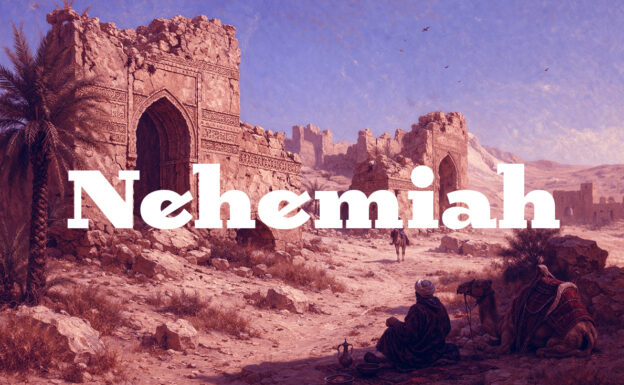
With ANZAC Day recently past, it reminds us that sometimes in war citizens lay down their tools and take up a rifle to fight for a cause. We can hope and pray that none of us (or our children) need to do that. In the Christian life though, the battle is constant and we battle against the devil and our sins as we labour. We have to carry both a sword and a trowel.
Nehemiah’s citizens were faced with attack by the devil, and were forced to defend themselves from what was a spiritual attack (with physical consequences). But the work continued. So they laboured on, with sword strapped to waist and a trowel in their hand. They battled on against the enemy, even as they laboured for God. We too, as we await Jesus’ return, battle on with a spiritual sword strapped to our waist as we labour for Christ’s Kingdom.
With opposition to the wall rebuild turning to threats of violence, Nehemiah ensured that a defence of the people and their work was in place. Nehemiah also encouraged God’s People to trust in God to deliver them, and remember that God is great and awesome.
Word reached Sanballat and the opposition that Nehemiah and the Jews were aware of their threats to attack them when they did not suspect it (v.15). As Nehemiah writes, God had “frustrated their plan” to stop the work. But the threat did not end there.
They all returned to the task of rebuilding the walls (v.15). But due to the threat of violence, half of the labourers worked on constructing the walls while half stood guard, holding “the spears, shields, bows, and coats of mail” (v.16). While the immediate threat was gone, Nehemiah wisely prepared for future threats.
Since an attack could come from any direction, and nobody can be strong everywhere, Nehemiah also created an early warning system. “The leaders stood behind the whole house of Judah, who were building on the wall” (vv.16-17) to direct and sound the warning if an enemy approached.
Those who were carrying burdens did so to be able to work with one hand and hold a weapon with the other (v.17). Those who were working on the wall “had his sword strapped at his side while he built” (v.18).
Nehemiah remained centrally located, overseeing the work, with a trumpeter permanently stationed beside him (v.18). Nehemiah advised the nobles and officials that since they were so widely spread with the amount of work required, “in the place where you hear the sound of the trumpet, rally to us there” (vv.18-19).
Yet they were not to fear they were fighting alone. “Our God will fight for us” (v.20). Nehemiah understood that they were obeying God’s will by rebuilding the walls, securing the centre of worship of God in the world. Securing the place, whether they understood it entirely or not, where the single act of redemption for sins would in a few short centuries take place. Just as God had intervened in the past, so too he would intervene for them.
The dedication of God’s people despite the risks and fears that come with it were shown in their approach to the work. They laboured from dawn until the stars came out; far later than sundown when work would usually cease so you could get home to see and eat (v.21).
At the same time, the protective cloak of the half complete wall and the organised guards was extended to those living outside Jerusalem’s walls (v.22). Everyone worked and slept in the same clothes, so they were ready to rise and fight at a moment’s notice (v.23). Even Nehemiah did the same, sharing the trial with those under his leadership.
This picture of a sword in one hand and a trowel in the other is a picture for our own life today. Our greatest foes are not generally physical ones, but spiritual enemies. Sometimes, we do not know where the spiritual attack will come from, only that it will come. Therefore, we must prepare ourselves by putting on spiritual armour to defend ourselves against the Devil’s attacks (Ephesians 6).
At the same time, we are called to serve the Lord. We cannot be tools used to build God’s Kingdom if we are only armed for spiritual warfare. With one hand on the sword of God’s word, we must also use a hand to serve God in the different ways he has called us, through acts of service to build the church and care for those we have opportunity to interact with.
This is a task that we are all called to. Every leader, just like Nehemiah, must share the same trials as the rest of us.
As we do so, we can take courage that Christ is in charge, watching over us all, and directing affairs. Jesus will lead us to victory over our enemies, for he has already decisively defeated sin and death. Our God will fight for us, just as God fought for Nehemiah.